Home Blog Page 2

Is Anti-Müllerian Hormone a reliable marker in Assisted Reproduction for mature women?

In the realm of assisted reproduction, the Anti-Müllerian hormone (AMH) is frequently employed as the gold standard for evaluating women’s ovarian reserves. Additionally, AMH can be a helpful marker for anticipating the ovarian response to controlled ovarian stimulation, cycle cancellation, and menopause timing. However, reports regarding the findings on the prognostic factor of AMH for clinical pregnancy and live birth in assisted reproduction are contentious. This might be due to the presence of several confounding factors like quality and quantity of the embryo transferred rate and age of the females.

A study published in BioMed Central, a part of Springer Nature showed that AMH should not be used as a marker among Women at Advanced Age (WAA) for predicting the quality of oocytes as they have a limited role in ascertaining the potential of embryo development both in-vitro and in-vivo reproduction. This study supported the idea of numerous egg retrievals to increase the probability of accumulating top-quality embryos for facilitating successful pregnancy in WAA.

Xiuliang Dai Xiuliang Dai et al conducted a retrospective study to understand the relationship between AMH concentration and oocyte quality. The WAA (= > 37 years) who are undergoing in-vitro fertilization (IVF)/ embryo transfer (ET) and, Intracytoplasmic sperm injection (ICSI), were divided into two groups, AMH high group (H) and AMH low group (L).

The results showed that women in the L group reported a high primary diagnosis rate of diminished ovarian reserve (DOR) and high basal follicle-stimulating hormone (FSH), the hormone that stimulates the growth of the eggs in the ovaries. However, they had low antral follicle count (AFC) and reduced embryo formation. AFC is the resting follicle that appears as a small fluid-filled sac containing immature eggs. It is measured by a transvaginal scan (TVS). 

Nevertheless, they reported the same rate of fertilization and blastocyst formation as women in the H group. Both groups encountered similar implantation rates, spontaneous miscarriage rates, and live birth. However, the probability of conceiving and sustaining pregnancy was lower in the L group. 

The overall results indicated that the level of AMH was not associated with the process of fertilization and implantation in WAA.

Healthy babies and in-fertility therapies

A healthy baby is a  prime goal for couples who are undergoing in-fertility therapies. Thus, the embryo that finally develops into a healthy child is the hallmark of the quality of oocytes. In this study, a higher rate of successful embryo transfer was associated with high implantation rates, promising successful chances of live births. The findings of this research will act as a ray of hope for aged women willing to have a baby. 

Women at Advance Age with low AMH  are the most complex cases for infertility specialists. Gynecologists have very low expectations about the success of pregnancy with this group and this indirectly erodes the confidence of the patients.  This scientific work indicated that low AMH will not hamper the probability of having successful implantation provided the best quality embryos are retrieved by multiple oocyte retrieval events for successful fertilization and subsequent implantation.

References

Broer, S. L., Broekmans, F. J., Laven, J. S. & Fauser, B. C. Anti-Mullerian hormone: ovarian reserve testing and its potential clinical implications. Hum. Reprod. Update 20, 688–701. https://doi.org/10.1093/humupd/dmu020 (2014).

Grisendi, V. & La Marca, A. Individualization of controlled ovarian stimulation in vitro fertilization using ovarian reserve markers. Minerva Ginecol. 69, 250–258. https://doi.org/10.23736/S0026-4784.17.04044-8 (2017).

Kruszynska, A. & Slowinska-Srzednicka, J. Anti-Mullerian hormone (AMH) as a good predictor of time of menopause. Prz Menopauzalny 16, 47–50. https://doi.org/10.5114/pm.2017.68591 (2017).

Cimadomo, D. et al. Impact of maternal age on oocyte and embryo competence. Front. Endocrinol. 9, 327. https://doi.org/10.3389/fendo.2018.00327 (2018).

Dai, X., Wang, Y., Yang, H., Gao, T., Yu, C., Cao, F., … & Chen, L.. AMH has no role in predicting oocyte quality in women with advanced age undergoing IVF/ICSI cycles. Scientific Reports, 10(1), 19750. https://doi.org/10.1038/s41598-020-76543-y (2020)

Image credit: Gianni Scognamiglio en Unsplash

The Scientist’s journey from Academia to Industry – A User’s guide (Part 2)

I discussed in a previous article the first steps in the process of moving from academia to industry: taking the decision to leave academia and finding purpose for your new professional life. In this second part, I discuss the practicalities of finding that new job. It includes finding target jobs and applying for them.

Needless to say, there are virtually endless paths to get out of the traditional academic pathway. I describe here the standard path of applying for pre-existing positions. I made this choice because it is the most straightforward action to take and the outcomes are expected. Nevertheless, in these times of hyper flexibility in high-skilled job markets, there is no one-size-fits-all approach. Therefore, many other possibilities such as entrepreneurship, consultancy, volunteering, and further training, among others, are not covered here.

The first thing to bear in mind is that, very likely, the transition from academia to any other kind of job will be a trial-and-error process. If you haven’t done this new job or a similar one before, there will be significant uncertainty if you and the new job fit. Employers know or should know, that. 

So, you should approach the job search with that mindset: you are entering into a process whose outcome, at this stage, you ignore. Furthermore, it might take time, some bad moves, and a lot of uncertainty. The key is to be curious and not fearful and take whatever happens as an experience and learning. Fear is rarely a good advisor. You should embrace uncertainty and the things you ignore at this stage.

Finding target jobs.

This will likely be the toughest part. If you can figure out in which jobs out there you picture yourself having a more or less good time while making a more or less significant contribution, you already went half of the road. Again and again, being honest with yourself will allow you to distinguish a feeling from a mirage, saving you lots of time, energy, and disappointment.

Finally to the point: what are the concrete jobs that might be good for you? There are a couple of routes to be considered; there may be plenty more I forget or I’m just not aware of. The options are listed in a roughly chronological sequence, although iterations and changes in the sequence will occur.

Linkedin. Whether you like it or not, Linkedin, if used wisely, helps a lot on many different fronts: networking, finding job opportunities, being contacted by recruiters, getting to understand jobs and companies of interest, and many more. I log in to my Facebook profile maybe twice a year but I do it every single day on Linkedin (I’m not saying I’m proud of that). So, work on your Linkedin profile. It is by far more fun than writing Cover letters or customizing your CV.

I could write a whole article on how to have a decent Linkedin profile (on the sloppy assumption that mine is). As this is not the main aim of this piece, I will provide some general tips:

  • Have a profile picture that looks professional and reflects who you are. 
  • Do not pay to improve your profile at anyone anytime. Only you know what it should look like. It might take some time until you reach a version that makes you happy, you will train your eye through time and use. Ask for help if you needed it (everybody knows someone on Linkedin these days).
  • Do not abuse (indeed avoid) slogans such as problem solver, result oriented, outside of the box thinker. Use wording that describes truthfully who you are and what it is unique about you. On the other hand, do not use jargon; it is ok to dare some informality but do not sound condescending, disrespectful, or childish.
  • Be as short as possible, always to the point. Exemplify your claims with concrete examples.

Some of the main uses of Linkedin during your job hunt are:

1. Networking: You’d be surprised how willing to help can be people on Linkedin if you contact them asking for advice. I even got quite some influential folks accepting to give talks with no previous interactions other than Linkedin (I would not exclude mere luck here). 

The route here would be: you send a connection request, the other person accepts and then you can chat asking for a phone or video call. What is important here is that you introduce yourself shortly and clearly, and you make your question right away:  What do you want from this person? Golden rules: be transparent, clear on your requests, and respect other people’s time: some like to chat, some don’t or do not have the time. Respect both. 

There is something else that is very important: listen. You might not get the answer you expected. It could happen that you are not a great fit for the job/company/field. Do not argue, make questions to understand why. It is up to you to agree or not, but if you don’t, keep it for yourself and make clear to yourself why (again and again, embrace whatever comes). Truth can hurt but it is always wiser to look at things right in the eyes, even if they are not nice.

2. Recruiters (AKA headhunters). Do not forget they buy and sell candidates, and they get paid for it. They are not your friend, nor your foe. They are just hunting candidates that might fit their clients’ opening positions. If they see you fit with one of their opening positions, they will show interest in you, sometimes borderline with harassment. They will promise you the moon as far as they see a potential fit. However, they will forget you pretty quickly if they don’t see that. This is the way it works. Their job – and the most you should expect from them –  is to get you an interview with the employer.

Here is a proposal on how to interact with recruiters on Linkedin:

  • Identify recruiting agencies active in your field of expertise or interest.
  • Within the company, identify the recruiters. Usually, their positions include the word associate, consultant, or alike. Send them via chat on Linkedin or via email a short and clear explanation of who you are and what you are looking for, attaching your CV and a Cover letter. 

Usually, you can have fairly open discussions with recruiters about your wishes and doubts. It all boils down to whether they have a position that might fit your profile.

3. Apply for open positions. Linkedin is also a good place to search and apply for open positions. Given the importance this network has in professional communities, the offer is very large. Also, the job openings you receive based on your previous searches are usually very pertinent.

Job search engines.  Indeed and Monster are very popular. You can set weekly notifications. I suggest not doing it daily, as your email inbox will become useless due to the flood of emails.

Company websites. Once you identify a job you would like to do, it is good practice to identify places where that position exists and check their openings regularly. There is nothing more annoying than finding out you missed an interesting opening.

Open application. Yes or no? Personally, it never worked. Nonetheless, it is not forbidden. You can try it, although I would not spend much time or energy on that. A more effective strategy is to approach someone in the company who might be related to your job of interest (the manager) and send that person an open application. If you do that, I would advise asking for an open conversation rather than an open application.

Applying for jobs

Preparing your CV. In my case, writing a CV from scratch feels like writing “El Quijote”. No matter how hard I try I will not be happy with the outcome. Don’t panic. Below you will find my tricks to make the experience less frustrating.

-Your CV should be one page long if you have 3 to 5 years of experience after your Ph.D. Two pages if you have more experience but never three or more pages.

-The first thing to bear in mind is the physical structure. For instance, how you are going to distribute the text on the page. In my case, that was the most difficult part. A solution if you run out of inspiration: copy. You can browse the internet for examples and choose the one that looks fancy and appropriate. Just use it.

Unless it is required in the job description, do not include in your CV a list of publications. I repeat, do not. For sure, you spent countless hours and sleepless nights doing what it took to get that paper published. Even so, if your potential new job is not about publishing papers, which is the most frequent cause, a full-blown list will show that you think like an academic and therefore that you are not ready to leave academia.


The CV is about showcasing the experience you gained in your previous positions: specific skills and the outcomes. The latter is not supposed to be an exhaustive list but highlights what you achieved with some kind of KPI (number of projects or collaborations ran, money raised, number of people you trained, etc).

Golden rule: if you care about the position you are applying to, adapt your CV to the position. There is no one-size-fits-all CV for two applications. If you send a general CV, it could be seen very quickly that you did not take into account the job description to prepare it and most likely that will put you out. Do you have to write an entirely new CV for each application? No. 

There are two tricks you can use to easily customize your CV for each application: 

  • Copy statements from the job description into your CV. If you do not overdo it is perfectly fine. It shows that you understood what the job is about and that you identify the key aspects of it. You can copy/paste keywords or catchphrases that are more related to your experience.
  • Make your CV modular. That means that your CV is made of blocks that you can modify independently and move around. This is useful, for instance, to list your outcomes or skills accordingly to what is described in the job description.

Preparing your Resume/Cover letter. I’ve seen some discussion about the need to ask for Cover letters at all. I guess it is a personal thing, but I think they are useful. It allows you to put into perspective your experience and focus on your motivations, why you did what you did, and where you want to go.

A Cover letter should be a story of your working life. The trick is to find a connecting wire, a plot, that gives sense to all the things you’ve done and for which this new job is a logical next step. It should be no more than one page long, font size 11.

The same advice applies to the CV in copying/pasting from the job description and modularity, in this case, paragraphs. 

A potential structure for your Cover letter could be:

  1. Introduce briefly yourself: what is your driver and why did you apply for the job. Write this in paragraph one.
  2. List your experience but do not repeat what is on your CV. Focus on the why and not on the what.
  3. Summarize in a few lines what did you learn from all this.  It could be personal and/or professional, and where you want to go next. Make it clear that this job fits perfectly with what you are looking for.
  4. In a couple of lines describe why you are a good fit for the job.

And this is the end of the second part. In the third and final piece, we will discuss how to prepare for the different interviews and their follow-up. 

See you there!

Picture By Emanuel Leutze – The Metropolitan Museum of Art, Public Domain, https://commons.wikimedia.org/w/index.php?curid=9520770

Research reveals promising results in expanding treatment for gallstone diseases.

Medicaid is the principal source of subsidy for therapeutic and health-related facilities in the United States for individuals with low income. In 2014, President Obama signed the Affordable Care Act (ACA) to make health protection more reasonably priced for them. Thus, Medicaid Expansion addressed the health disparities originating from poor or no insurance.

A recent article published in the Journal of Surgical Research estimated the incidence and fatality rate of ambulatory and emergency cholecystectomies in New Jersey. This article sheds light on whether the Medicaid expansion transformed cholecystectomy trends. 

Cholecystectomy is a common treatment for gallstones and gallbladder conditions. Approximately 600 thousand individuals undergo this practice each year in the United States. A previous study about uninsured and Medicaid-covered U.S. hospitalizations stated that cholecystectomy was the most common surgical procedure in 2012. However, there are limited data on the longitudinal trends of this medical intervention and its consequences.

Gregory and collaborators designed a retrospective population cohort to investigate the occurrence of cholecystectomy and its fatality rate in the US, from 2009 to 2018. They postulated that the 2014 Medicaid expansion would decrease emergency cholecystectomies, increase ambulatory practices – any action happening outside of the hospital –  and not affect the fatality rates.

Results

Matching their expectation, the researchers identified a noticeable reduction in the incidence of emergency cholecystectomies. Largely, almost 10 thousand (93.423) emergency cholecystectomies had been performed across the hospitals, with 644 fatalities. In contrast, they identified 87.239 cases of ambulatory cholecystectomies, with less than 10 fatalities. 

Emergency cholecystectomies’ annual occurrence plummeted remarkably from 114.8 to 77.5 per 100.000 population in New Jersey, from 2009 to 2018. Whilst ambulatory cholecystectomies rose from 93.5 to 95.6 per 100.000 population, which was in line with the study hypothesis. 

Medicaid expansion decreased the rate of uninsured individuals by 42% in New Jersey. Therefore, the subsequent greater than-before access to healthcare facilities likely made appropriate interventions possible for people with gallstone diseases. In other words, greater ambulatory cholecystectomies contributed to lesser emergency cholecystectomies, and, thus, fewer surgery-related deaths.

The cases of emergency cholecystectomies plunged after the Medicaid expansion. Moreover, Gregory and the team identified a decrease in fatality among people aged over 65 years undergoing emergency cholecystectomies after the Medicaid expansion. However, this reduction was not elucidated by health insurance.

The researchers mentioned that these trends are influenced by Medicaid expansion. This policy allowed public health intermediation for thousands of additional people.  

The strongest key of this research was the inclusion of data on all entitled patients in a distinct population before and after the expansion. Nevertheless, the team emphasized the need for more studies to acknowledge other interventions that may improve the overall incidence of gallstone diseases and reduce mortality.

References

Peck, G. L., Kuo, Y. H., Hudson, S. V., Gracias, V. H., Roy, J. A., & Strom, B. L. (2023). Decreased Emergency Cholecystectomy and Case Fatality Rate, Not Explained by Expansion of Medicaid. journal of surgical research, 288, 350-361. https://doi.org/10.1016/j.jss.2023.03.006

Lopez-Gonzalez, L., Pickens, G. T., Washington, R., & Weiss, A. J. (2014). Characteristics of Medicaid and uninsured hospitalizations, 2012.

Sommers, B. D., Arntson, E., Kenney, G. M., & Epstein, A. M. (2013). Lessons from early Medicaid expansions under health reform: interviews with Medicaid officials. Medicare & Medicaid research review, 3(4). https://doi.org/10.5600%2Fmmrr.003.04.a02 

Ambur, V., Taghavi, S., Kadakia, S., Jayarajan, S., Gaughan, J., Sjoholm, L. O., … & Goldberg, A. J. (2017). Does socioeconomic status predict outcomes after cholecystectomy?. The American Journal of Surgery, 213(1), 100-104. https://doi.org/10.1016/j.amjsurg.2016.04.012 

Kocher, R., Emanuel, E. J., & DeParle, N. A. M. (2010). The Affordable Care Act and the future of clinical medicine: the opportunities and challenges. Annals of internal medicine, 153(8), 536-539. https://doi.org/10.7326/0003-4819-153-8-201010190-00274 

Citizen science: participating in the data collection phase is key to improving people’s scientific learning

Citizen science projects, also known as Public Participation in Scientific Research (PPSR), have been gaining popularity worldwide as a way for the public to engage in scientific research. Educational goals and personal development have been identified as key outcomes of these programs. However, how the degree of participation in the scientific process translates into individual outcomes is not clear. Moreover, there are not many clues as to whether successful examples of co-creating PPSR programs at the local level are feasible on a large spatial scale and entirely online.

To address these gaps, researchers from Cornell University, in the US, analyzed the results of the Bird Cams Lab’s investigations called “Battling Birds: Panama”. This citizen science project engaged thousands of people in observing bird behavior through a virtual platform with online cam watchers. The study aimed to examine how providing opportunities to engage in multiple stages of the scientific process relates to individual learning and in which ways the degree of participation is associated with such outcomes.

From December 2020 to June 2021, approximately 2,014 participants participated in optional activities spanning the entire scientific process, including question design, data collection, and data exploration. The scientific team surveyed them before and after their engagement in the research.

Image. PanamaFruitFeederCam @PanamaFeederCamGray-cowled Wood-Rail looking for leftover rice 7:41 4/30

Science inquiry skills learning

Researchers found that the degree of participation was significantly linked to the participants’ science inquiry skills improvement. Those who engaged in diverse phases of the investigation showed the greatest advance. Other significant predictors included age, education level, and participation in other Bird Cams Lab investigations. Remarkably, gender and science training was not important as improvement predictors.

The findings also align with experiential learning theory, which suggests that knowledge is created through the transformation of experience. Taking part in scientific programs boosts self-efficacy, content knowledge, and self-perceived development of science inquiry skills. Participants who contributed to data visualization and shaping the investigation had the highest self-perceived learning outcomes.

The study published in the journal “Citizen Science: Theory and Practice” concluded that engagement in data collection was associated with greater gains in participants’ self-efficacy and content knowledge compared to other phases. This suggests that programs with limited funding and resources should focus on data collection to get the most impactful way to improve participant-level outcomes.

References
Mady, RP, Phillips, TB, Bonter, DN, Quimby, C, Borland, J, Eldermire, C, Walters, BT, Parry, SA and Chu, M. 2023. Engagement in the Data Collection Phase of the Scientific Process is Key for Enhancing Learning Gains. Citizen Science: Theory and Practice, 8(1): 14, pp. 1–16. DOI: https://doi.org/10.5334/cstp.594

Aristeidou, M and Herodotou, C. 2020. Online Citizen Science: A Systematic Review of Effects on Learning and Scientific Literacy. Citizen Science: Theory and Practice, 5(1): 1–12. DOI: https://doi.org/10.5334/cstp.224

Borland, J. 2021. From Bird Cams to Scientific Inquiry: Seeking greater understanding of experiences and outcomes that result from co-created scientific investigations. Available at https://www.informalscience.org/bird-cams-scientific-inquiry-seeking-greater-understanding-experiences-and-outcomes-result-co.  

Kolb, DA. 1984. Experiential Learning Experience as the Source of Learning and Development. Englewood Cliffs, NJ: Prentice Hall.

Masters, K, Lintott, C, Holmes, K, Greenhill, A, Simmons, B, Oh, EY, Cox, J and Graham, G. 2016. Science learning via participation in online citizen science. Journal of Science Communication, 15(3). DOI: https://doi.org/10.22323/2.15030207

Prather, EE, Cormier, S, Wallace, CS, Lintott, C, Jordan Raddick, M and Smith, A. 2013. Measuring the Conceptual Understandings of Citizen Scientists Participating in Zooniverse Projects: A First Approach. Astronomy Education Review, 12(1). DOI: https://doi.org/10.3847/AER2013002

Shirk, JL, Ballard, HL, Wilderman, CC, Phillips, TB, Wiggins, A, Jordan, R, McCallie, E, Minarchek, M, Lewenstein, BV, Krasny, ME and Bonney, R. 2012. Public participation in scientific research: A framework for deliberate design. Ecology and Society, 17(2). DOI: https://doi.org/10.5751/ES-04705-170229

Image credit: Christian Rucinski on Unsplash

The scientist’s journey from academia to industry – A user’s guide (Part 1)

0

I did my Ph.D. in the cellular biology of brain tumors, identifying new ways to treat this aggressive and, to date, incurable disease. At that time, I was, and still I am, fascinated by the origins, development, and plasticity of cancers. I was so enthusiastic about understanding cancer biology to develop therapeutic tools that I decided to pursue a career as a researcher. So I did my first postdoc, and then the second one, and then the third one. At the end of the third one, I realized that I was walking on a dead-end road. I had a good shot at a permanent position in a lab I liked but it didn’t work out…for administrative reasons. When I had the news it was like an epiphany: you have to leave the boat,  ASAP; you did your best, some things worked, some others didn’t. Overall, it is not enough to stay in the system and things will just get worse from now on. So it was time to open the door to the outside world and start a transition that continues today and will go on in the future. It has been exciting, scary, stressful, fun, enriching, and full of learnings about how the world works and how I work. It was necessary, and it was difficult in moments. It was absolutely worth doing it.

In this article, divided into three parts, I want to share my learnings on the process of transitioning from academia to industry. By industry, I mean any job in the private sector. I will walk you through this process through the following stages: 1. deciding to leave academia, 2. refocusing the meaning of a professional career, 3. exploring the outside world, and 4. getting your first job outside academia. You can consider these as tips or tools you can use or not. Maybe all of them make sense to you, maybe some, maybe none. When you get advice and it doesn’t make sense to you, just don’t do it, it’s not for you but for someone else. That is the only strong piece of advice I can give you here.

1-Taking the decision (not) to leave academia

The key to taking the right, or least wrong, decision here is being honest with yourself. You have to ask yourself the hard, painful, questions and give yourself honest answers, because the answers are already in you.  You just have to give yourself the time and energy to let them come out. The more you delay this, the more complicated it will get. 

Why do you want to stay in academia? It is okay to be passionate about something but,  is it because it is cozy here and you are afraid of the cold, unfriendly, ruthless world out there? The news is that academia can also be cold, unfriendly, and ruthless. The difference is that in academia it will take you many years to face the ugly truth, but sooner or later it will happen. 

Another important question is, what are your real chances to get a job in academia that will fit your current expectations? With real chances, I mean what is the concrete evidence you have, right here right now, that there is a place for you. Personally, if your evaluation includes lots of ifs that hide more ifs (if I publish this paper in a good journal, if my boss gets this funding, if my application for this university works) your chances are low. Networking and mentoring in academia are useful and necessary, but the most you can expect from them is to get a foot in the door for you. The weight of politics in the hiring process changes from country to country, and it will hardly create new opportunities for you.

A third and very important question is what kind of lifestyle you want. Are you okay with working long hours, with short holidays? Are you willing to relocate for a job? Is it fine for you not to have a great work-life balance? Being a postdoc, chasing the next temporary contract not knowing exactly where that will lead you might be okay when you are young, you do not have children, and you can move more or less easily from one place to the other. However,  that most likely will change with time. You might want to settle somewhere, have a house, have children, or enjoy your free time. You should understand to what extent the prospect of your current job opportunities in academia match your lifestyle expectations and those dear to you.

Fact: the job market situation in academia is pretty difficult, and the lack of perspectives is leading young life scientists and postdocs to leave academia and join the industry, which points to the need for a change in academia’s career structure. Certainly, those changes, although necessary, will not happen tomorrow, or the day after.

Once more or less you figured out all these questions -and many others that will depend on your situation- you can summarize them in what would be your motivations to stay or leave, which is the most important thing here. If you are motivated enough to stay, then this is the end of this article for you. If you realize that the effort and risk/reward ratio of staying is not a good deal, then let’s move to the next stage.

2-Repurposing your professional career

So you decided to leave, what now? There are a couple of things that should happen simultaneously, as they will affect each other in an iterative process: networking, applying for jobs, getting new soft/hard skills (if required), among others. Here, I want to discuss an important topic, sense. When you do scientific research, the question of sense is in general pretty straightforward: you want to figure out how the world works and contribute to the understanding of the universe, or something similar. That specific purpose can be also found outside academia, although is less common and you might find it in different shapes and flavors, most likely as far as it is required to solve a concrete problem. 

When you start looking outside academia for jobs is like going to a supermarket in the 1980s USSR compared to Amazon nowadays: if you are used to supermarkets in the USSR, there are one or two types of everything (if any), you know what to expect and if you like it or not it doesn’t matter, it is what it is. On Amazon nowadays you can find almost endless products which might resemble but all claim to be different, and also unexpected products which claim to be a solution to your need. Looking for jobs in the life sciences industry coming from academia can feel like that: it’s a never-ending discovery of options, which makes it interesting, but also overwhelming because you do not know what else is out there which might be a better fit for you. Jobs in the industry can be also tailor-made, meaning that they can be adapted, to a certain extent, to your skills and motivations. 

How to identify your driver for that new job? Given the diversity of job offers, knowing that will make your job search easier,  I think there are two possibilities here. Although, is also good to stay open-minded.

First, you can have a strong motivation for something, in particular, you do not want to give up on, like developing new technologies, helping a particular group of people, or doing research. In that case, you should identify the jobs that fit those motivations. The second option, you are not sure, the change is so big and there are so many unknowns that you feel lost. That is perfectly okay as far as you acknowledge it. In this case, I propose that you first identify your strongest skills, with which you feel comfortable, like doing experiments, networking, project management, people management, or writing. Then you can look for jobs for which these skills are required and see if you can picture yourself doing it. By doing so you will see if that motivates you. The interesting thing is that often you find motivations you did not know you had. 

This is the end of the first part. You decided you want to leave academia and you have more or less a clear idea of what type of jobs you would like to do. The second part will deal with finding a good match and getting prepared for the recruitment process. The third and final part will discuss the interview process and getting the job. See you there!

Image: Géricault, ThéodoreFrance, Musée du Louvre, Département des Peintures, INV 4884 – https://collections.louvre.fr/ark:/53355/cl010059199 – https://collections.louvre.fr/CGU

Opioid stockpiling at home linked with higher overdose

Opioids are substances predominantly used for the management of pain. They are also used as anesthetics, and for treating cough, shortness of breath, diarrhea and constipation, and hyperalgesia. According to a recent study published in JAMA Network Open, the availability of household opioids has been related to greater risks of opioid overdose.

Every year 69. 000  people die of opioid overdose globally. Moreover, opioid addiction has been diagnosed in 15 million persons. 

In 2016, the World Health Organization reported that 34 million people use opioids. In the US,  70.200 overdose-related deaths occurred in 2017, 47.600 of them were related to opioids,  accounted one female death for three males. 

Considering the high prevalence of opioid overdose, 31st August is celebrated as International Overdose Awareness Day to pay respect to those who have lost their lives to overdose. Thus, promoting the deterrence of overdose and reducing the stigma around it is a pressing need.

The recent study was led by Michelle A. Hendricks from Comagine Health in Portland, Oregon. Hendricks and collaborators mentioned that the impact of domestic opioid prescriptions on the odds of opioid overdose was restricted to commercial statements in previous studies. Furthermore,  earlier researchers did not consider fatal opioid overdoses.

In this new approach, the team inspected the impact of household opioid accessibility and additional factors for household opioid prescription linked to the risks of nonfatal or fatal opioid overdose. This retrospective cohort study comprised more than a billion adults selected from the Oregon Comprehensive Opioid Risk Registry database. They belonged to 1.187.140 houses, each one with at least 2 members and they were adults who live at the same address and may not be on the same insurance policy or have familial ties. Participants were examined from January 1, 2015, until December 31, 2018.

The team looked for opioid overdose in death records, hospital discharge files, and insurance dues. Hendricks and colleagues identified 28.747 opioid overdose occasions (0.0526 per 100 person-months). The risk of opioid-associated overdose raised by 60% when a  person in the family house filled an opioid prescription in the previous six months, compared to those without domestic or personal opioid fills. 

They found out, also, the greatest risks of opioid-associated overdose when both – the selected person and another member of the household – filled opioid prescriptions in the last six months. 

Results of this research emphasize that the availability of domestic opioid prescription is related to greater risks of opioid overdose for other members of the household, apart from the patient, even if the former has not been prescribed opioids. Hendricks mentioned that their findings highlight the prominence of enlightening patients regarding the risks of storing opioids.

References

Hendricks, M. A., El Ibrahimi, S., Ritter, G. A., Flores, D., Fischer, M. A., Weiss, R. D., … & Weiner, S. G. (2023). Association of Household Opioid Availability With Opioid Overdose. JAMA Network Open, 6(3), e233385-e233385. doi:10.1001/jamanetworkopen.2023.3385

Khan, N. F., Bateman, B. T., Landon, J. E., & Gagne, J. J. (2019). Association of opioid overdose with opioid prescriptions to family members. JAMA internal medicine, 179(9), 1186-1192. doi: 10.1001/jamainternmed.2019.1064

Overdose Death Rates | National Institute on Drug Abuse. (2022, July 21). National Institute on Drug Abuse. https://web.archive.org/web/20221005054752/https://nida.nih.gov/research-topics/trends-statistics/overdose-death-rates

Enforcement, F. L. (2016). International Overdose Awareness Day—August 31, 2016. Vital Signs. doi: 10.15585/mmwr.mm6834a1

Parthvi, R., Agrawal, A., Khanijo, S., Tsegaye, A., & Talwar, A. (2019). Acute opiate overdose: an update on management strategies in emergency department and critical care unit. American journal of therapeutics, 26(3), e380-e387. doi: 10.1097/MJT.0000000000000681.

Picture credit Isaac Quesada in Unsplash

First Globalization and what can we learn from it

To most of us, the globalized, interconnected world is the only world we know. However, it has not always been like that and there are no guarantees that it will remain the same. The period between 1870 and 1914 is designated as the first systematic attempt at globalization. The process enriched the European working class and landowners of the New World and negatively affected European landowners and native-born New World workers. Moreover, it enabled the rise of Germany as a world power and its ambitions for greater geopolitical importance, which eventually caused World War I. 

The main lesson we can learn from the first globalization and apply it to the current situation is to ensure the socio-economic security of the workers in the global North, who have lost the most due to trade liberalization. By creating social security for poor people, Western countries can prevent the rise of nationalism. Furthermore, considering the rise of China and its geopolitical ambitions, the world needs to be cautious about potential conflict.

The First Globalization

The first globalization or the first wave of globalization describes the financial and economic interactions and integration between states taking place from 1870 to 1914. It followed technological advancements that lowered transportation costs and reduced tariff barriers.  Innovations in the transportation system, such as steamships and railways, made it easier to travel across continents and transport large commodities by land. In the nineteenth century, economic specialization occurred. The former colonies mainly located in south and north America and Australia often referred to as the “New World”, produced food and raw materials, which Europeans transformed into manufactured goods. The development of cheaper and more efficient transportation made it easier to increase the trade of land-intensive products to manufacturers. As a result, the share of exports in world income doubled, reaching approximately 8%. (Collier & Dollar, 2002, p. 24-25).

Mass immigration from Europe to the New World increased the productivity of both the Europeans who left and the ones who stayed. The large-scale production of primary goods required people. Europe was densely populated, while the population in the western hemisphere was low. These conditions motivated many Europeans to look for new opportunities overseas. During the 19th century, around sixty million Europeans migrated to North America and Australia, bringing an overall positive impact on economic growth and welfare. (Collier & Dollar, 2002, p. 25).

Some economic historians believe that similar processes took place in South and East Asia. Lindert and Williamson (2001) in Does Globalization Make the World More Unequal? wrote how millions of people moved from densely populated China and India to neighboring countries. Based on this speculation, the labor movement during the first globalization reached about 10% of the entire world population.

It was not just the labor but also the capital that the New World received from Europe. At the beginning of the first wave of globalization, foreign capital stocks made up a marginal percentage of the New World budget; however, over time, the development of European-style financial institutions and the enhanced information exchange allowed governments to attract European capital. As a result, before World War I, the foreign capital stock share of the GDP of these countries increased from 9 to 32 %. 

The first wave of globalization had a positive economic impact on the world, particularly for the New World countries that actively participated in international trade. The annual per capita income increase rate, which was 0.5% for the past 50 years before the first globalization, went up to 1.3%. Countries like Argentina, Australia, New Zealand, and the United States became the leading economies in the world by selling food and other primary commodities, opening up to new immigrants, and capital, and establishing European-style institutions (Collier & Dollar, 2002).

Globalization was economically beneficial for many former colonies that embraced liberal trade practices. However, its effects on different segments of society are not as straightforward. The biggest losers in the New World were workers whose wages went down. Due to the mass immigration, it is estimated that wages in Argentina went down by 22%, 15% in Australia, 16% in Canada, and 8% in the United States. On the contrary, in Europe, emigration raised Irish workers’ wages by approximately 32%, Italian by 28%, and Norwegian by 10% (Collier & Dollar, 2002, p. 25-26). Ultimately, immigration was the most important factor that equalized wages between the Old World and the New World.

Unlike workers, the biggest winners of globalization in the former colonies were land owners because the countries primarily exported food and raw materials. Considering their colonial past, it is not surprising that land itself was unfairly distributed, which determined who benefited from trade. The exception to this tendency was West Africa, where land was owned more equally. 

In the case of Europe, landowners were the biggest losers of globalization. The economic effects of globalization changed European societies in a few fundamental ways. First, in various countries, it undermined the power of the aristocracy because the land was their main economic asset. Second, European countries introduced social protectionist reforms, such as public education, worker insurance, and pensions. 

Although first globalization was not able to stop the pre-existing trend of increasing global income inequality, it had an unprecedented effect on reducing poverty. For the 50 years before 1870, poverty was falling at the rate of just 0.3 % annually. It increased by 0.8 % during globalization. However, due to the increase in population, the overall number of poor people went up (Collier & Dollar, 2002, p. 26).

World War I and the Return of Nationalism 

The successful decades of globalization and liberalization were crashed by World War I, which made countries retreat into nationalism. It can be argued that World War I itself was a byproduct of the first wave of globalization. Economic historians, Adam Tooze and Ted Fertik, in The World Economy and the Great War, emphasize the fact that the war was fought using the raw materials transported internationally by the British shipping companies and paid mostly by American loans (2014, p. 221). In other words, the first systematic attempt to create a global, inter-connected economic structure also enabled the first truly international conflict.

Moreover, the first globalization altered the status quo in terms of power dynamics, which created the foundation for a military conflict. The rise of Germany as an economic superpower in the 19th century happened by embracing liberal economic practices. As German economic and political power grew, so did their geopolitical ambitions and their desire to have a great influence over global trade. One of the common understandings of World War I is that it was Germany, a rising power, challenging Britain, the “status quo” power (O’Rourke, 2022).

World War I motivated countries to return to protectionism. The Nobel Prize-winning economist, Robert Mundell, in A Reconstruction of the Twentieth Century wrote that “the twentieth century began with a highly efficient international monetary system that was destroyed in World War I, and its bungled recreation in the inter-war period brought on the great depression.” (2003, p. 225). States responded to the depression with protectionist policies. The most notable, the United States, the world’s leading economy at that time, introduced the Smoot-Hawley Act. The legislation increased tariffs on imports by approximately 20 %. As a result of the economic restrictions, between 1929 and 1933, American imports fell by 30 % and exports by 40 % (Collier & Dollar, 2002, p. 26).

The protectionist policies undermined the first globalization advances. The export share of world income in 1950 was 5% – almost identical to what it was in 1870. The governments, especially in higher-income economies, implemented regulations that forbade the export of capital. As a result, many lower-economy countries that had liabilities suffered severely (Collier & Dollar, 2002, p. 26).

The rise of nationalism created strong anti-immigration sentiments, particularly towards racial minorities. During the period of 1914–1950, immigration to the United States was only 6 million, which is a significant decline from the 15 million in 1870–1914. Anti-immigration feelings were not solely an economic reaction, as O’Rourke explains, they also had a racial dimension. “Yes, immigration restrictions in the United States were linked to the impact of immigration on wages, but even a cursory examination of the relevant legislation shows an obsessive concern with Asian immigration in particular. No one reading Avner Offer’s account of how anti-Asian racism was ubiquitous throughout the late nineteenth century Anglosphere could be in any doubt that ‘culture’ was a powerful factor underlying late nineteenth-century immigration restrictions,” writes O’Rourke (2022, p.367-368). 

The period of nationalism reversed the decline of global poverty and further enhanced economic inequality. The global rate of economic growth fell by a third, which negatively affected the incidence of poverty, returning it to the period between 1820 and 1870. Despite an apparent socioeconomic regress caused by the rise of nationalism, one aspect of the living conditions that continued improvement was life expectancy. It was largely due to the increased accessibility of health innovations (Collier & Dollar, 2002, p. 27).

The Third Globalization

Since then, there has been a return of globalization. The period, starting in the 1980s, in which we are still living is commonly described as the third wave of globalization. It has two main characteristics: technological developments and unprecedented liberalization of trade and capital markets. The development of technology lowered the cost of transporting products globally and enhanced communication. Regarding liberalization, with the facilitation of intergovernmental organizations like the World Bank, the International Monetary Fund, and the World Trade Organization, countries have become increasingly less protectionist in their economic policy, lowering import quotas, tariffs, and other non-tariff barriers. As a result, the world today is as economically interconnected as ever before (Ertekin & Dural, 2004).

Although the process of liberalization started before the third wave of globalization, its effects became the most notable after the 1980s. Arguably, one of the most significant geopolitical events that enlarged the global economic community was the end of the Cold War and the collapse of the Soviet Union and the Eastern Bloc. The breakdown of the communist superpower in 1991 made many political scientists believe that liberal democracy with free trade was an uncontested political structure. The idea has recently become more questionable. 

Another important characteristic of the third wave of globalization, which is similar to the first globalization, is a high level of migration. For example, during the period of 1980-2000, international immigration increased from 100 million to 175 million. Although it was largely driven by people fleeing from the former-Soviet countries, the tendency continued in the following decades. In 2010, the number of international migrants reached 213 million. The migrants during 2000-2010 primarily came from Asia and Latin America. The military conflicts in the Middle East and Ukraine that took place after 2010 further increased the level of migration from the global South to the North (Ertekin & Dural, 2004, p. 56-57).

The third wave of globalization was the time when many developing countries managed to capitalize on their abundant labor. During the past decades, labor-intensive manufacturing has been outsourced from the West to lower-income places in Asia and Latin America. For example, in 1980, only around a quarter of the exports of developing countries were manufacturing goods. Since then, it has changed drastically, and already by 1998, the share of manufacturing rose to 80 % (Collier & Dollar, 2002, p. 31-32). This example is a clear demonstration of how the third wave of globalization fundamentally changed the world economy.

There is an increasing backlash in the West against the globalization process, particularly from the workers who have lost the most from the new wave of economic liberalization. In the last few years, we witnessed Britain’s exit from the European Union, the election of Donald Trump, and other right-wing politicians. They often use populist economic messages to attract groups that feel economically dissatisfied with neo-liberal economic practices, as well as cultural nostalgia. 

In 2016, professor of Public Policy, John Rennie Short, at the University of Maryland published an article exploring the reasons behind the backlash against globalization. “The backlash against economic globalization is most marked in those countries such as the U.S. where economic dislocation unfolds with weak safety nets and limited government investment in job retraining or continuing and lifetime education,” writes Short. “Indeed, the fear of immigration has resulted in the most dramatic backlash against the effects of globalization, heightening national and racial identities. In the U.S. white native-born Americans  moved from being the default category to a source of identity clearly mobilized by the Trump campaign.” In other words, the economic losses of working-class Westerners caused by globalization, paired with the identitarianism after mass migration resulted in the election of right-wing politicians. The changing nature of Western politics makes the future of countries, as well as globalization, uncertain. For that reason, it is even more useful to examine the First Globalization and its aftermath to learn lessons for the future.

The main lesson that we can learn from the first globalization is that globalization is not irreversible. Domestic and geopolitical shocks can have consequences that can undermine the progress made during the globalization process. As Findlay and O’Rourke write in Power and Plenty: Trade, War, and the World Economy in the Second Millennium “It is natural to suspect that the accumulating economic and geopolitical tensions unleashed in the course of each period of peace, prosperity, and trade culminate in successive rounds of conflict, so that wars, rather than being exogenous or external shocks to the world system, have been inherent in its very nature.” (2009, p. xxv)

To further develop this idea using the example of the first globalization and World War I, we see how the rising economic powers that benefited from the liberal economic practices want to translate their economic success into political influence. Germany, which was a beneficiary of the first globalization, challenged the status quo by attempting to enlarge its geopolitical importance. In our time, we see this with China. The East Asian superpower became increasingly aggressive in its geopolitics only after its economic success. Although it is still ambiguous whether China will attempt to gain greater political power through direct military confrontation with the West, politicians, and societies need to remember that the modern-day global conflict will be even more disastrous than the previous ones. The rise of nationalism around the world is another worrying sign that can potentially undermine trade liberalization and cause military conflicts. The setback in trade liberalization will be catastrophic for the global South, particularly its poor, who barely earn living wages.

On a microeconomic level, the main lesson of the first globalization for Western countries is to compensate the working class for the economic losses caused by globalization. Western corporations and economic elites are the main beneficiaries of liberal trade practices. Their wealth has reached an unprecedented level, while there is little improvement for the lower classes. Western governments need to use the wealth of their capitalist elites to ensure the social safety of the rest of the population to make them less vulnerable and more resilient to populist politicians. 

Although the first wave of globalization made the world more prosperous overall, it still created both winners and losers. The European working class and landowners of the New World became richer, while European landowners and native-born New World workers’ wealth declined. The globalization process which is taking place today is similar to the first globalization in many ways, including the improvement of technologies, a decline in trade barriers, and a high level of immigration. Considering these similarities, there are lessons we can learn from the past. First, the rise of China and its geopolitical ambitions, as well as the rise of nationalism around the world, should make us cautious about a potential conflict. Second, the Western government should create a stronger social security net to compensate its workers for the loss that they have experienced due to globalization and prevent their further political radicalization.

References

Collier, P., & Dollar, D. (2002). Globalization, growth, and poverty building an inclusive World Economy. Oxford University Press. 

Ertekin , M. S., & Dural, B. Y. (2004). International Migration and the globalization of Domestic Politics: A conceptual framework. International Migration and Globalization of Domestic Politics, 19–46. https://doi.org/10.4324/9780203488379-7 

Findlay, R., & O’Rourke, K. (2009). Power and plenty: Trade, war, and the World Economy in the Second Millennium. Princeton Univ. Press. 

Lindert, P., & Williamson, J. (2001). Does globalization make the world more unequal? https://doi.org/10.3386/w8228 

O’Rourke, K. H. (2019). Economic history and contemporary challenges to globalization. https://doi.org/10.3386/w25364 

O’Rourke, K. H. (2022). Globalization. https://nyuad.nyu.edu/content/dam/nyuad/academics/divisions/social-science/working-papers/2022/0075.pdf 

Persson, T. (2003). Economic Sciences: 1996-2000. World Scientific. 

Short, J. R. (2016, November 30). Column: Why there’s a backlash against globalization and what needs to change. PBS. Retrieved January 10, 2023, from https://www.pbs.org/newshour/economy/column-theres-backlash-globalization-needs-change 

Tooze, A., & Fertik, T. (2014). The World Economy and the Great War. Geschichte Und Gesellschaft, 40(2), 214–238. https://doi.org/10.13109/gege.2014.40.2.214 

Picture The New York Public Library on Unsplash

Unfolding Impressionism: how Turner and Monet documented pollution

Impressionism, the popular art style that emerged in the 19th century, is often celebrated for its vibrant colors and ethereal quality. However, a new study suggests that there is more to these paintings than meets the eye. According to research published in PLOS, Impressionism contains elements of polluted realism. In the 19th century, air pollution reached unprecedented levels due to the Industrial Revolution. Even though direct measurements from this time period are scarce, paintings from this era could document longer-term environmental change.  The study conducted by a team of scientists from the United States and Europe shows that artists such as Turner and Monet documented changes in atmospheric pollution in London and Paris through their paintings, providing a unique window into historical trends in air quality.

The article demonstrates that the progression toward hazier contours and whiter color palettes in Turner and Monet’s paintings and other artists is consistent with the optical changes expected from higher atmospheric aerosol concentrations. Monet and Turner’s stylistic changes from more figurative to impressionistic suggested that their works could capture elements of the atmospheric environmental transformation during the Industrial Revolution. 

The study used a mixed-effects model to analyze the paintings, which allowed the researchers to account for both temporal and environmental trends. The model showed a significant dependence on emissions of sulfur dioxide -SO2 emissions-, indicating that atmospheric pollution contributed to depicting the contrast in Turner and Monet’s paintings. The researchers note that while there are limitations to using paintings as a proxy for historical air quality, the evidence provided is complementary to instrumental measurements.

Painting pollution

Anthropogenic aerosol emissions increased dramatically during the 19th century due to industrialization, particularly in Western European cities. Researchers investigate whether changes in atmospheric conditions were reflected in changes in painting style. They focused on Turner and Monet, who frequently painted landscapes and cityscapes during the Industrial Revolution. The team analyzed the contrast between 60 oil paintings by Turner and 38 paintings by Monet.

They found that Turner and Monet’s paintings underwent a visual progression from sharp to hazier contours, more saturated to pastel-like coloration, and figurative to impressionistic representation. Accordingly, a mixed-effects model showed that local SO2 emissions were a highly significant explanatory variable for the observed trends in contrast and intensity across the artists’ works. The findings suggest that both painters captured changes in the optical environment associated with increasingly polluted atmospheres during the Industrial Revolution.

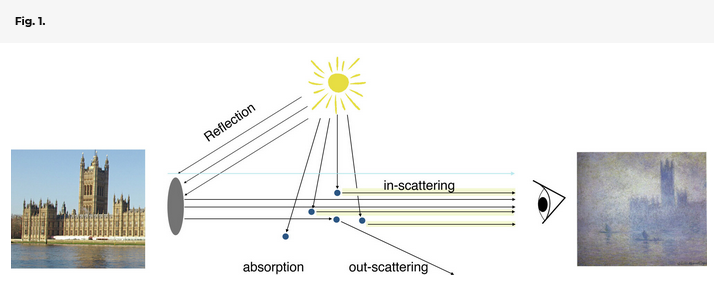
Impressionist art. Schematic illustrating key processes by which aerosols influence an object’s contrast, intensity, and visibility. A theoretical object (denoted by the gray disk) reflecting light (black arrows) is visible because of its contrast with the background light (pale blue arrow). Aerosols (navy dots) in the air column scatter background light into the line of vision (“in-scattering,” highlighted in light yellow), scatter object light out of the line of vision (“out-scattering”), and absorb light. These optical effects from aerosols lead a viewer to perceive an object as having less-distinct edges (less contrast) and a whiter tint (increased intensity), as idealized by the images on the left- and right-hand side (Claude Monet’s Houses of Parliament, Effect of Fog, 1899–1904)

Even when industrialization changed the environmental context in which painting occurred, the degree of decreased contrast and increased intensity representing physical, and optical changes associated with a polluted atmosphere is uncertain. Even so, the team proposed two further considerations about environmental trends rendered in the works of Turner and Monet. 

On one hand, the environment depicted in their paintings was subject to large trends in atmospheric pollution. On the other, Turner and Monet likely intended to represent environmental change. Turner spoke about finding artistic material in his environment, while Monet’s serial views of London’s House of Parliament, Waterloo Bridge, and Charing Cross Bridge indicate a deliberate effort to capture the changing environment.

The study also brought to light some letters where Monet wrote about the role of air pollution in his creative process, “What I like most of all in London is the fog”. This makes it possible to infer that he did not choose the scenes to paint randomly. According to earlier investigations, there is some evidence that Monet chose to paint on days when ambient air pollution would have been higher on account of meteorological conditions. 

Artistic work and environmental conditions

Overall, researchers pointed out that the new atmospheric conditions revealed in the paintings of Turner and Monet could inform environmental research, providing insights into the state of the atmosphere before the advent of widespread, direct measurements. Furthermore, this work demonstrates the potential of artistic works to provide a unique perspective on historical environmental change.

Researchers also highlight that the analysis has implications beyond the art world. With megacities such as Beijing and New Delhi experiencing levels of air pollution similar to those of 19th-century London, this approach drives attention to the impact that environmental change can have on how we see the world.

Moreover, they indicate that the evidence about Turner, Monet, and others depicting physical atmospheric conditions provides additional, complementary opportunities for appreciating and interpreting their artwork. “Our view is that impressionistic paintings recording natural phenomena—as opposed to being imagined, amalgamated, or abstracted—does not diminish their significance; rather, it highlights the connection between environment and art”, researchers pointed out. 

References
Albright, A. L., & Huybers, P. (2023). Paintings by Turner and Monet depict trends in 19th-century air pollution. Proceedings of the National Academy of Sciences of the United States of America, 120(6). https://doi.org/10.1073/pnas.2219118120

Brimblecombe, P. (1977b). London air pollution, 1500–1900. Atmospheric Environment, 11(12), 1157–1162. https://doi.org/10.1016/0004-6981(77)90091-9

Corton, C. L. (2015). London Fog: The Biography. Harvard University Press.

Mage, D. T., Ozolins, G., Peterson, P. A., Webster, A. K., Orthofer, R., Vandeweerd, V., & Gwynne, M. D. (1996). Urban air pollution in megacities of the world. Atmospheric Environment, 30(5), 681–686. https://doi.org/10.1016/1352-2310(95)00219-7

Shaw, W. N. (1901). The London Fog Inquiry. Nature, 64(1670), 649–650. https://doi.org/10.1038/064649b0

The pictures showcase in the article belong to the paper: Albright, A. L., & Huybers, P. (2023). Paintings by Turner and Monet depict trends in 19th-century air pollution. Proceedings of the National Academy of Sciences of the United States of America, 120(6)

Simulating phases of matter in magnetic materials with qubits

Investigating the collective behavior of atoms or molecules leading to phases of matter is crucial to understand phenomena such as magnetization, superfluidity, and superconductivity. The laws of quantum physics govern the underlying dynamic of such collective behavior; however, simulating the quantum dynamics involving large number of atoms is often impossible for classical computers.

In 1982, Nobel Prize winner Richard Feynman anticipated that this difficulty might be overcome by using a controllable quantum system to study another less accessible quantum system. This controllable quantum system we can use to understand other physical situations is known today as a quantum simulator.

Scientists from Université Paris-Saclay and The French National Centre for Scientific Research (CNRS), in collaboration with other institutions [1], including scientists from PASQAL, investigated phases of matter in magnetic materials at the atomic level using a neutral atoms quantum processor. They successfully used rubidium atoms (ranging from 42 to 100 qubits) to emulate the quantum dynamics in materials leading to two different magnetic phenomena known as ferromagnetism and anti-ferromagnetism.

Ferromagnetism is present in iron, cobalt, nickel, some rare-earth elements, and specific alloys. Examples of anti-ferromagnetic substances are manganese oxide, chromium, and nickel oxide.

These new experimental results for the 42 qubits were fully comparable with a simulation for the same system performed by the Research Computing Group at Harvard University and at the University of California, Berkeley.

“Successfully benchmarking that kind of complex experiment can require very detailed simulations. We usually start at a small system size, with four qubits arranged in a square, and make sure we understand everything happening during the quantum dynamics, then we scale up the simulations to 42 qubits. At this point, we needed to make some approximations to be able to run them in reasonable times in a computer cluster,” clarifies Lucas Leclerc, Quantum Software Engineer at PASQAL, who was directly involved in the experiment.

However, none of the state-of-the-art classical computers involved in this study could simulate the dynamics for the 100 atoms case. Although it was impossible to compare with classical simulations, the experimental observations using 100 qubits are consistent with theoretical expectations. These results were published in Nature.

But what are ferromagnetic or anti-ferromagnetic materials? And how can we use rubidium atoms to recreate the quantum collective behavior of iron or chromium atoms and the emergence of these magnetic phases in matter? Let’s dive into the details.

Atoms as tiny magnets

Ferromagnetic materials can be turned into magnets by applying an external magnetic field, and their magnetic properties remain even after the external magnetic field is turned off. This behavior comes from their fundamental properties at the atomic level. In these materials, their atoms act as tiny magnets — a quantum property called spin — due to their internal electronic structure. When the external magnetic field is applied, it influences the spins and since they are close enough to each other in the material, each spin also influences their neighbors reinforcing each other, getting aligned all together, turning the material into a magnet itself.

To illustrate ferromagnetism, imagine that we represent the atomic spin with arrows (like the magnetized arrow in a compass). In the ferromagnetic phase, all the heads of the arrows can be found pointing in the same direction with the same probability.

Spins orientation in the ferromagnetic phase. Image from Université Paris-Saclay.

This kind of magnetism is destroyed at high temperatures. When the material is heated to a certain temperature called the Curie point, different for each material, it ceases to be a magnet.

In anti-ferromagnetism, the atoms also act as tiny magnets but, in this case, at low temperatures, they spontaneously align in opposite directions so that their magnetism cancels out and the material does not exhibit any macroscopic magnetic properties. This antiparallel collective behavior disappears upon heating the material to a specific temperature called the Néel point.

Again, imagine the spins as arrows; their heads would alternate in opposite directions in the anti-ferromagnetic phase.

Spins orientation in the anti-ferromagnetic phase. Image from Université Paris-Saclay.

Emulating the emergence of ferromagnetism and anti-ferromagnetism with qubits

In their work, Antoine Browaeys, Thierry Lahaye, and colleagues used neutral rubidium atoms, each of them trapped with intense fine-tuned lasers called optical tweezers, to recreate a quantum model — known as the XY model — of how two-dimensional ferromagnetism and anti-ferromagnetism emerge in nature.

With these optical tweezers, the scientists placed the rubidium atoms in a square array — one with 42 qubits and the other with 100 qubits — representing how atoms in the ferromagnetic material would be organized. Then, they encoded the ferromagnetic material atomic spin by bringing the rubidium atoms to their Rydberg states. Rydberg states are very high-energy electronic states where atoms get polarized, behaving as tiny dipoles. Each of these dipoles interacts with its neighbors, recreating the way the atoms in the original ferromagnetic material interact with their neighbors.

At this point, the dipoles can be oriented in any direction. With this experimental setup, the scientists emulated the quantum dynamics happening in a magnetic material, in two dimensions, before ferromagnetism or anti-ferromagnetism emerged.

By shining light of specific frequencies onto each of the dipoles and controlling that there is no heat transfer in the process, they brought the array to the ferromagnetic phase where all the dipoles get aligned, with the heads of the arrows pointing in the same direction all at once. This model is fully quantum, and because we can only calculate probabilities in quantum physics, these spins, pointing all in the same direction, can be measured to be in any direction with equal probability.

The scientists repeated the experiment, but this time starting from a different energy state and driving the system to the anti-ferromagnetic phase, with the heads of the neighboring arrows pointing in antiparallel directions, again in any antiparallel direction with the same probability.

High-quality science leading to disruptive technologies

In a previous paper, also published in Nature, Antoine Browaeys, Thierry Lahaye, and collaborators already demonstrated their capacity to realize a simpler model, known as the Ising model, of anti-ferromagnetism using 196 qubits. However, that experiment model did not require the level of control needed for this new experiment, where they realized the full quantum XY model, for which the scientists developed new technologies that significantly improved their control over each qubit with high fidelity.

“For me, as an experimentalist, an important aspect in this experiment, beyond the physics results themselves, is that we were able to put together all these new tools, these new lasers, that allowed us to achieve a high level of control over each atom in the array with high fidelity,” explains Thierry Lahaye, Researcher at the French National Centre for Scientific Research (CNRS), and co-founder of PASQAL.

This experimental advance is a big step forward in improving quantum simulations for systems with many atoms and in developing the quantum computer’s fidelity, where we need absolute control of every single atom.

This novel experiment performed at the Université Paris-Saclay in France opens the door to exploring the quantum dynamics of many-body interactions in a programmable quantum simulator in situations where traditional classical methods fail. Innovations in quantum computing will enable us to understand real-life problems, such as in material science or molecular medicine.

PASQAL’s technology is based on high-quality scientific knowledge produced together with our collaborators from world-class institutions. Last year, we demonstrated our capacity to control hundreds of neutral atoms in our quantum processors, and we are now on a solid road map to achieve thousands of qubits.

References

Chen, C., Bornet, G., Bintz, M. et al. Continuous Symmetry Breaking in a Two-dimensional Rydberg Array. Nature (2023). https://doi.org/10.1038/s41586-023-05859-2. Preprint available: 2207.12930.pdf (arxiv.org).

[1]Full list of institutions: Universite Paris-Saclay, Institut d’Optique Graduate School, CNRS, Laboratoire Charles Fabry, University of California, Berkeley, PASQAL SAS, California Institute of Technology, Nanomaterials and Nanotechnology Research Center (CINN-CSIC), Universidad de Oviedo (UO), Technical University of Munich, Munich Center for Quantum Science and Technology (MCQST), Universitaet Innsbruck, Laboratory for Theoretical and Computational Physics, Paul Scherrer Institute, Institute of Physics, Ecole Polytechnique Federale de Lausanne (EPFL), Lawrence Berkeley National Laboratory, Berkeley, Harvard University.

This article is originally written for Pasqal

Sleep disorders in children make parents more stressed

Stress and sleep disorders are interdependent, with stress impacting sleep quality and poor sleep having negative effects on stress levels and coping ability. This creates a cycle that harms an individual’s health and quality of life. 

A study by Ray M. Merrill and Kayla R. Slavik published in Plos One found that stress is significantly elevated in parents who either have sleep disorders or have children with sleep problems.

The study analyzed almost 14 thousand adult employees with children from the US.  The results showed that parents with insomnia were three times more stressed than other participants, and the ones suffering from apnea had almost two times higher stress levels. Additionally, if children had any sleep disorder, their parents suffered nearly two times greater stress and offspring with insomnia increased parental stress up to three times. 

The rates of parental stress were 90% higher if their child had a sleep disorder, 189% higher if the child had insomnia, and 81% higher if the child had sleep apnea. The link between children’s insomnia, apnea, and parents’ stress was stronger for women.

The findings led researchers to propose that a deeper understanding of the association between parent and child sleep, and parent stress may lead to more effective treatment and reduce the risk of such disorders.

Sleep disorders in children

Child sleep disorders are prevalent and earlier studies indicated that these behaviors are influenced by complex interactions between parents’ sleep, stress, mood, and fatigue. 

A 2021 study by Lawrence T Lam suggested a potential connection between early childhood sleep disorders and mental health issues such as anxiety, depression, and ADHD in teenagers.

Throughout adolescence, various internal and external factors can impact a young person’s mental health, with sleep disorders being a symptom of underlying mental health problems. Childhood sleep disorders also have a link to mental health issues, particularly bipolar disorder and schizophrenia, leading to increased parental stress.

Parental stress increasing

Parents of children with mental health or sleep difficulties have a higher chance of developing sleep disorders such as insomnia, hypersomnia, and sleep apnea. These issues can raise stress in forms like daytime sleepiness and decreased performance. 

Child sleep disorders and parental stress interact in complex ways, affecting both parents and child’s mental health. Prolonged sleep latency, inability to stay asleep and early morning awakening are linked with mental health disorders such as depression. 

In a study held in 2019, Martin and the team found that sleep problems in children were linked to more stress for parents and worse mental health for the affected kids. The stress brought about by a child’s mental health or sleep issues can exacerbate the symptoms of the parents and raise their probability of developing mental health problems.

How to have a good night sleep

The key to enhancing the sleep health of the entire family is consistency, although there are several other measures that can be taken.

  1. Establish a consistent sleep routine: A routine helps regulate sleep patterns, making it easier for everyone to fall asleep and wake up at the same time every day.
  1. Create a sleep-conducive environment: A quiet, dark, and cool room can help create a relaxing and peaceful environment.
  1. Limit screen time before bedtime: The blue light from screens can interfere with sleep, so it’s important to limit screen time at least an hour before bedtime.
  1. Exercise regularly: Regular physical activity can help improve sleep quality and relieve stress.
  1. Avoid caffeine and heavy meals close to bedtime: Caffeine and heavy meals can interfere with sleep, so it’s best to avoid consuming them close to bedtime.
  1. Encourage relaxation before bed: Relaxing activities such as reading a book, taking a bath, or meditating can help prepare the mind and body for sleep.
  1. Avoid napping during the day: Napping can interfere with nighttime sleep, so it’s best to limit naps to no more than 20-30 minutes.
  1. Address sleep disorders: If anyone in the family is struggling with sleep disorders such as insomnia, hypersomnia, or sleep apnea, seeking medical treatment is recommended.
  1. Reduce stress: Stress can interfere with sleep, so it’s important to find healthy ways to manage stress, such as practicing mindfulness or exercising.

References.
Merrill RM, Slavik KR. Relating parental stress with sleep disorders in parents and children. PLoS One 2023; https://doi.org/10.1371/journal.pone.0279476

Meltzer LJ, Mindell JA. Relationship between child sleep disturbances and maternal sleep, mood, and parenting stress: a pilot study. J Fam Psychol 2007; 21: 67–73. DOI: 10.1037/0893-3200.21.1.67

Lam LT, Lam MK. Sleep Disorders in Early Childhood and the Development of Mental Health Problems in Adolescents: A Systematic Review of Longitudinal and Prospective Studies. Int J Environ Res Public Health; 18. Epub ahead of print 10 November 2021. DOI: 10.3390/ijerph182211782.

Martin CA, Papadopoulos N, Chellew T, et al. Associations between parenting stress, parent mental health and child sleep problems for children with ADHD and ASD: Systematic review. Res Dev Disabil 2019; 93: 103463. DOI 10.1016/j.ridd.2019.103463