Home Blog

Your Health Is In Your Mouth

Many individuals recognize the significance of regular brushing and flossing for cavity prevention. Yet, did you realize that oral health can provide valuable insights into your overall well-being?

Your oral health acts as an essential guide to your general physical condition. It often shows indications of systemic ailments within the mouth before they are clinically identified. Evidence from several studies points to a link between periodontal disease and systemic diseases such as diabetes, heart disease, gastrointestinal disorders, endocrine problems, blood-related diseases, cancer, obesity, osteoporosis, and neurological disorders which often can be discovered during a routine visit to the dentist.

Systemic Diseases Linked to Oral Health
A study conducted by Atrium Health’s Carolinas Medical Center in the United States reveals that systemic disorders can have significant effects on the oral cavity and its various components, including the gums, teeth, and periodontium, in diverse manners. These disorders can affect the growth of periodontitis, affecting the well-being of the tissues that provide support to the teeth, even in the absence of inflammation caused by dental plaque. Consequently, they can increase the rate and severity of periodontitis, which can result in a slow breakdown of the tissues that support the teeth (Jepsen et al. 2018).

Diabetes
Diabetes is a major contributing factor to periodontitis, and there is a bi-directional relationship between periodontitis and diabetes. The duration of diabetes, regardless of the specific diabetes type, influences the severity of periodontitis development (Lalla and Papapanou 2011). People with diabetes experience inflammation, which increases the injuring processes that break down periodontal tissue.
Likewise, individuals suffering from periodontitis encounter a decline in their capacity to maintain blood glucose levels as a result of insufficient metabolic regulation. Hence, periodontitis enhances the likelihood of diabetic complications.

Hypertension
In most cases hypertension is treated non-specifically, resulting in a large number of minor side effects. A 2019 study conducted by the University of Medicine and Pharmacy in Romania (Javot et al. 2011) found that people with hypertension have oral symptoms that are directly linked to high systolic and diastolic blood pressures. Gingival bleeding is one of the most common conditions among hypertensive patients. A research led by Kumar, showed that antihypertensive medications may cause side effects which raises the chance of developing tooth decay (Kumar et al. 2012).
Some common oral conditions in hypertensive patients are:

  • xerostomia (dry mouth),
  • gingival overgrowth,
  • salivary gland swelling or pain,
  • lichenoid drug reactions,
  • erythema multiforme,
  • taste sense alteration, and
  • paresthesia

    Furthermore, insufficient oral health can have an adverse effect on the control of blood pressure, potentially leading to gum bleeding and periodontitis.

    Heart Disorders
    Patients with heart diseases, such as atherosclerosis, myocardial infarction (MI), and rheumatic heart disease (RHD), have a higher chance of developing periodontal diseases.
    From 14% to 67.4% of people taking cardiovascular medication develop oral side effects. For instance, Amlodipine and nifedipine gingival hyperplasia or nodules affect all areas of the marginal gingiva. Also, Aspirin, statins, and diuretics can cause abnormalities in taste perception.
    Besides, Captopril and other angiotensin-converting agents have been associated with the development of lichen planus, as well as causing a “burning mouth” sensation and ageusia, according to research conducted by Farzin et al. 2016.
    Craniofacial pain is observed too, in approximately 4% of individuals with angina due to the mixing of cardiac sensory inputs into the trigeminal nerve, which is found in the teeth and jaw, as described (Ratheesh et al. 2015).

    Gastrointestinal Disorders
    The oral cavity can display symptoms of systemic gastrointestinal disorders, such as those observed in inflammatory bowel disease. It can result in erythema and ulcers, usually found on the palate and uvula. Gingivitis, periodontitis, and dental erosion resulting in tooth sensitivity and/or pulpitis are symptoms of gastroesophageal reflux disease (GERD), as research published in 2020 pointed out. (Napeñas et al. 2020).
    Patients with GERD commonly experience various oral complaints such as:
  • excessive salivation (sialorrhea),
  • dry mouth (xerostomia),
  • burning sensation,
  • greater sensitivity of the tongue,
  • bad breath (halitosis),
  • feeling of a lump in the throat (Globus sensation),
  • altered taste (dysgeusia),
  • painful swallowing (odynophagia), and
  • increased sensitivity to hot or cold substances on the teeth (dental thermal sensitivity).

    Chronic Kidney Disorder
    People with long-standing kidney disease often experience a higher prevalence of oral lesions and conditions due to the systemic effects of the disease. The main cause is the reduced glomerular filtration rate, which impairs the body’s ability to filter out toxins and maintain proper fluid balance. This can result in a buildup of waste products and electrolyte imbalances, contributing to oral manifestations such as:
  • abnormal lip pigmentation,
  • halitosis (bad breath),
  • periodontitis (gum disease), and
  • candidiasis-like lesions (fungal infections in the mouth).

    Anemia
    Patients with Anemina may experience:
  • tongue soreness
  • burning sensation or tingling
  • loss of papillation
  • ulcerations.

    Iron deficiency anemia may show various oral symptoms, such as:
  • dysgeusia (alteration in taste perception),
  • ageusia (complete loss of taste), and
  • angular cheilitis (inflammation and cracking of the corners of the mouth).

    Vitamin deficiency
    Some deficiencies in Vitamins can affect oral health. Vitamin A (Retinol) and Vitamin E Deficiency increased periodontal disease and tooth loss. Vitamin B Deficiency produces a smooth, atrophic tongue (glossitis), which sometimes can cause pain or burning (glossodynia), and lips that crack and split (cheilitis), particularly in the corners of the mouth (angular cheilitis). Vitamin C (Ascorbic Acid) Deficiency generates spontaneous bleeding from the gingiva, mucosal ulcers, periodontal disease, and loss of mobility of teeth.

    Obesity
    A 2021 study conducted by the Medical University of Warsaw, Poland unveiled that obese patients show a tendency for greater plaque accumulation and periodontitis symptoms, which are characterized by inflammation of the gingival and periodontal tissues. Due to their increased consumption of sweets, fats, and dairy products, these patients have poorer oral hygiene and more advanced inflammatory changes in the periodontal tissues (Deszczyńska et al. 2021).

    Mental health diseases (stress, depression)
    Tooth decay is common among patients due to a lack of dental care as researchers found.(Vasiliou et al. 2016). Adverse effects of antidepressant medication or depression itself are:
  • Dry mouth
  • Parotid swelling,
  • biochemical abnormalities in saliva, and
  • dental destruction (perimolysis)
  • bruxism, or teeth grinding

Moreover, Stress can lead to various negative effects due to bruxism, including:
-thinning of tooth enamel,
-loss of fillings,
-increased susceptibility to tooth decay, and
-fractured or split teeth.
-Patient may clench the muscles of their jaw, resulting in jaw pain, tension, or tenderness.

Pregnancy
Pregnancy is associated with hormonal changes, including increased levels of estrogen and progesterone, which can lead to various physiological changes in the body, including the gums. Pregnancy can cause:
-gingivitis
-redness, swollen, and tender gums
-bleeding during brushing or flossing.
If left untreated, it can progress to more severe periodontal disease, affecting the tissues and bone supporting the teeth. Research suggests that pregnant women with periodontal disease may have an increased risk of certain obstetric complications, such as preterm birth or low birth weight.

HIV/AIDS (Human Immunodeficiency Virus/Acquired Immunodeficiency Syndrome)
Individuals living with HIV/AIDS are more susceptible to various oral manifestations, including:
-Oral Thrush (Candidiasis)
-oral ulcers,
-aphthous ulcers (canker sores),
-hairy leukoplakia
-gingivitis
-periodontitis
-swollen, bleeding gums,
-persistent bad breath,
-loose teeth
-dry mouth (xerostomia)
-Human papillomavirus (HPV) infection

A multidisciplinary approach involving dental professionals, physicians, infectious disease specialists, and other healthcare providers is essential for providing complete treatment and improving patient outcomes due to the complex nature of HIV/AIDS and its effects on different body systems.

Alcoholic liver disease
Sialadenosis is a condition that causes painless swelling of the parotid glands on both sides of the face. This condition is commonly seen in individuals with alcoholic liver disease and alcoholic cirrhosis.

Smocking
Smoking significantly harms the tissues that support the teeth, thus raising your risk of developing periodontitis. Tobacco use can cause a variety of oral changes, ranging from abnormalities in soft tissue to potentially fatal oral cancer. Smokers’ melanosis refers to the heightened pigmentation or darkening of tissues caused by irritation from tobacco smoke. Nicotinic stomatitis is characterized by the presence of white patches on the hard palate, along with multiple small raised areas that have red centers scattered throughout the palate.
The minor salivary glands become irritated and their duct openings become inflamed due to the heat generated by tobacco products.
Heightened susceptibility to developing cancer in the tonsils, posterior mouth, and lungs. Regionalised gingival recession and the visible dentition. Black Hairy Tongue occurs when there is an excessive growth of the regular bumps on the tongue or a reduced rate of their removal. Regular occurrence of malodorous

Conclusion
These are just a few examples, but they illustrate the interconnectedness of oral health with overall health and well-being. Regular dental check-ups allow for early detection and treatment of oral health issues, which can prevent them from progressing into more serious problems. It is vital for everyone, especially those with systemic conditions, to maintain good oral hygiene and attend regular dental check-ups. Individuals can prevent oral health complications and reduce the impact of systemic conditions on their overall well-being by focusing on oral health. Optimal oral health in individuals with systemic conditions can help in better management of their underlying health conditions. Individuals may achieve better overall health outcomes and quality of life by reducing oral infections and inflammation.

References
Deszczyńska, Katarzyna, Renata Górska, and Anna Haładyj. 2021. “Clinical Condition of the Oral Cavity in Overweight and Obese Patients.” Dental and Medical Problems 58 (2): 147–54. DOI: 10.17219/dmp/127873

Farzin, M., R. Derafshi, J. Ghapanchi, Ali Zarin Kafsh, and M. Rezaiee. 2016. “Oral Manifestations of Hypertension and Rheumatic Heart Disease : A Cross Sectional Study in Elderly Patients.” https://ajmpr.science-
line.com/attachments/article/39/Asian%20J.%20Med.%20Pharm.%20Res.%206(2)%2009-13,%202016.pdf.

Javot, L., J. Scala-Bertola, N. Petitpain, P. Tréchot, P. Péré, and P. Gillet. 2011. “Rheumatology-50.5.Letters 989..999.” http://www.rjor.ro/wp-content/uploads/2019/09/ORAL-MANIFESTATIONS-LINKED-TO-CARDIOVASCULAR-PATHOLOGY-OR-MEDICATION.pdf.

Jepsen, Søren, Jack G. Caton, Jasim M. Albandar, Nabil F. Bissada, Philippe Bouchard, Pierpaolo Cortellini, Korkud Demirel, et al. 2018. “Periodontal Manifestations of Systemic Diseases and Developmental and Acquired Conditions: Consensus Report of Workgroup 3 of the 2017 World Workshop on the Classification of Periodontal and Peri-Implant Diseases and Conditions.” Journal of Periodontology 89 Suppl 1 (June): S237–48. DOI: 10.1002/JPER.17-0733

Kumar, Prashant, Kmk Mastan, Ramesh Chowdhary, and K. Shanmugam. 2012. “Oral Manifestations in Hypertensive Patients: A Clinical Study.” Journal of Oral and Maxillofacial Pathology: JOMFP 16 (2): 215–21. DOI: 10.4103/0973-029X.99069

Lalla, Evanthia, and Panos N. Papapanou. 2011. “Diabetes Mellitus and Periodontitis: A Tale of Two Common Interrelated Diseases.” Nature Reviews. Endocrinology 7 (12): 738–48. DOI: 10.1038/nrendo.2011.106

Napeñas, Joel J., Michael T. Brennan, and Sharon Elad. 2020. “Oral Manifestations of Systemic Diseases.” Dermatologic Clinics 38 (4): 495–505. DOI: 10.1016/j.det.2020.05.010

Ratheesh, A. V., G. P. Sujatha, and Ashok Lingappa. 2015. “Craniofacial Pain as Manifestation of Angina.” International Journal of Oral Health Sciences 5 (2): 99.  DOI: 10.4103/2231-6027.178499

Vasiliou, A., K. Shankardass, R. Nisenbaum, and C. Quiñonez. 2016. “Current Stress and Poor Oral Health.” BMC Oral Health 16 (1): 88.
DOI: https://doi.org/10.1186/s12903-016-0284-y

Image: Engin Akyurt – Pixabay

From contraception to genetic therapies: promising developments in women and children’s healthcare.

0

What’s going on in the field of medical advances in gynecology, obstetrics and pediatrics? Post-pregnancy weight-loss pills captured much of the limelight in 2023 but it has left some other important scientific works to ponder upon.

New hope for Duchenne muscular dystrophy (DMD)
DMD is a genetic disorder causing faulty expression of dystrophin protein – crucial for muscle function – leading to muscle wasting. According to research published some years ago, it represents one of the most common recessive fatal inherited genetic diseases and children with DMD tend to have a shorter lifespan with progressive muscular disability.
In June, the FDA approved gene therapy for DMD increasing a hope for a better life for these patients. The recombinant gene therapy is designed to deliver a gene through a single intravenous dose for the treatment of ambulatory children aged four to five.
The therapy contains selected domains of dystrophin protein in normal muscle cells, helping to restore dystrophin function. 

No prescription required for contraceptives.
Birth control pills, first approved in 1973, will now be available as over the counter (OTC) medication. FDA approved the birth-control pill as a non-prescription drug in July 2023. The birth control pills belong to the class of progesterone that prevents pregnancy by inhibiting ovulation. This ground-breaking approval by the FDA will promote reproductive autonomy.

Postpartum depression (PPD) now has an oral pharmacological intervention.
Previously PPD was treated under in-patient settings with 60 hours long intravenous medication.,
In August, FDA
t raised the green flag for oral medication for PPD. Patients can take this medicine at home and positive prognosis in the mental health condition can be witnessed within three days. The oral medicine for PPD is different from the rapid-acting positive allosteric modulator of the GABAA receptor used to treat major depressive disorder (MDD). 

Additional vaccination during pregnancy
FDA also approved last year, the respiratory syncytial virus (RSV) vaccination for pregnant women and older adults. RSV vaccine isa type of monoclonal antibody targeted to synthesize RSV specific antibodies, ensuring comprehensive protection. The vaccine earned over-night popularity, leading to limited supplies. Thus, U.S. Centers for Disease Control and Prevention recommended reservation of vaccine stocks for the babies who are at highest risks. 

Gene Therapy for Sickle Cell Disease (SCD)
Further approval in gene therapy came in the month of December by FDA. CRISPR/Cas9 (clustered regularly interspaced short palindromic repeat, CRISPR-associated) gene-editing therapy was approved for the treatment of Sickle Cell Disease (SCD).
A genetic mutation makes red blood cells become crescent- or “sickle”. These sickled red blood cells do not bend or move easily and can block blood flow to the rest of the body. Therefore, serious problems could arise such as stroke, eye problems, infections, and episodes of pain called pain crises. Also, according to Frangoul and team, patients have shorter life-span causing anemia and splenomegaly.
CRISPR/Cas9 gene-editing therapy is targeted to synthesize normal Red Blood Cells helping to treat this disease. . By March 2024, FDA is planning to use CRISPR/Cas9 gene-editing therapy for the treatment of transfusion dependent beta-thalassemia, another blood borne genetic disorder. 

New ray of hope for treating morning sickness
Morning sickness is common among several pregnant women, leading to severe dehydration and weight loss. Research published in Nature showed that a surge of hormone (GDF15, acting on the brain stem), triggered by the fetus causes morning sickness. Women having low levels of protein in blood are susceptible to morning sickness, scientifically known as hyperemesis gravidarum. This path-breaking discovery can help in identification of susceptible women, leading to effective management of the disease.

References
Frangoul, H., Altshuler, D., Cappellini, M. D., Chen, Y. S., Domm, J., Eustace, B. K., … & Corbacioglu, S. (2021). CRISPR-Cas9 gene editing for sickle cell disease and β-thalassemia. New England Journal of Medicine, 384(3), 252-260. DOI: 10.1056/NEJMoa2031054
Mbakam, C. H., Lamothe, G., Tremblay, G., & Tremblay, J. P. (2022). CRISPR-Cas9 gene therapy for Duchenne muscular dystrophy. Neurotherapeutics, 19(3), 931-941.
DOI: 10.1007/s13311-022-01197-9
What is sickle cell disease? | NHLBI, NIH. (2023, August 30). NHLBI, NIH. https://www.nhlbi.nih.gov/health/sickle-cell-disease#:~:text=In%20sickle%20cell%20disease%2C%20red,the%20rest%20of%20the%20body.
Fejzo, M., Rocha, N., Cimino, I. et al. GDF15 linked to maternal risk of nausea and vomiting during pregnancy. Nature 625, 760–767 (2024). https://doi.org/10.1038/s41586-023-06921-9.
DOI: https://doi.org/10.1038/s41586-023-06921-9

Why industrialization took place in Britain and not in China

Greif and Tabellini, in Cultural and Institutional Bifurcation: China and Europe Compared, explore how cultures affect the development of different social organizations. They used the case studies of China and Western Europe during the pre-modern period to understand how their organizational bifurcation influenced their social and political development. The discussion aims to shed some light on the events that made possible the Great Divergence – known as the Industrial Revolution –  and the reasons why industrialization took place in Britain and not in China, the richest country until the nineteenth 19th century. 

Cooperation, society, and development

The author’s main claim is that Chinese society was dominated by kinship-based clans that fostered cooperation through inter-clan loyalty, while in Europe cooperation happened in cities, where the diversity of lineages and other identities demanded the creation of formal institutions that would universally enforce rules. 

A clan (lineage) is a kinship-based formation where cooperation relies on intra-clan moral ties and reputation. They are often small and hence require little external involvement to enforce rules and norms. The low enforcement costs can give clans a competitive advantage and make them attractive. In this kind of society, cooperation usually occurs between kin members, which further fosters kin loyalty. 

In China, the prevalence of kinship-based social structure is associated with Confucianism. After the Han Dynasty came to power, Confucianism which advocated for kin-based moral obligations as the foundation of social order replaced legalism that prioritized legal commitments. When the Han dynasty collapsed, China was split into smaller kingdoms. The areas dominated mainly by non-ethnic Chinese adopted Buddhism, which advocated for individual, monastic life, over Confucianism; However, soon after the ethnically Chinese Tang dynasty came to power and reunited China, they turned against Buddhism and destroyed thousands of Buddhist monasteries. Eventually, Confucian scholars formulated neo-Confucianism in a way that would be more appealing to the masses, while Buddhism was re-formulated to not undermine the importance of family and kin. As a result, by approximately 1000 AD, Chinese society was dominated by large kinship organizations.

The kinship-based social structure influenced the Chinese political system as well. Considering the large size of the Chinese empire, the ruling elites benefited from outsourcing some of their duties to clans. For example, clans had a responsibility to collect taxes, ensure the conduct of their members, and prepare them for civil service exams. Moreover, land could be purchased through the local clans.

In contrast with China, in Medieval Europe, the main form of cooperation took place in urban centers. Cities were attractive because of their large economies of scale. They were heterogeneous with different lineages and required external institutions for rule enforcement. Although moral obligations extended to an entire city population, they were not as strong as in the clan-based society. Therefore, formal agencies were necessary to ensure successful cooperation. The prevalence of cities as the main means of cooperation fostered a culture of universal morality and respect for institutional procedures. 

Historically, Europe also had strong tribal societies, but the Church’s emphasis on generalized morality and changes in marriage practices enabled the existence of functioning multi-lineage urban centers. When the Germanic tribes, which were organized through large kinship groups, invaded the Western Roman Empire, the tribal system briefly returned; However, as the Church became more powerful and influential, a generalized morality replaced tribal obligations. The Church changed the marriage practices in a way that undermined the kinship system. For example, practices such as polygamy, concubinage, and marriage among kin members were discouraged, while women gained greater agency in deciding their marriage partners. 

The emergence of cities with the absence of strong political and religious institutions in the 10th century created a need for more formal institutions in Europe. By the 10th century, both the Church and the States were weak. Cities, although secular, reinforced Christian dogmas, including moral obligations towards non-kin. 

Foundation for the Great Divergence 
The power of clans in China prevented the development of universal rules, while in European cities, reliance on formal institutions as an arbiter for ensuring cooperation created the economic and social foundation for industrial societies. The reliance on the clan enforcement of legal and social laws in China did not allow the creation of strong organizations that would regulate cooperation. Clan elders recognized that such agencies would weaken their power and therefore, opposed them. For instance, the Chinese state did not have a commercial code until the late 19th century because it relied on and encouraged intra-clan resolution of conflicts. Limited cooperation between clans was one of the reasons for the low urbanization in China between the  11th and  19th centuries, only three to four percent while in Europe it was around ten percent. Even in the Chinese cities, the clans dictated the rules of cooperation as opposed to the European self-governing cities. 

Self-governing European cities fostered formal institutions and created a foundation that transformed  a Malthusian into  an industrial system more easily. The historical records show how the urban European centers evolved from “handshake” to contracts. Moreover, the cities invested in legal systems, including building legal infrastructure and educating judges, attorneys, scribes, and notaries. These assets enabled the transition from having voluntary judges who relied on customary law to formal legal codes and professional judges. Over time European cities became progressively heterogeneous and multi-lineage with strong administrative capabilities, such as collecting taxes and even fighting wars. 

Although the authors do not explicitly link the different developments of Chinese and European societies and the great divergence, they present evidence that shows how in the eighteenth century, European cities were more suitable for industrialization than the Chinese clans-based society.

Grief and Tabellini’s article is a thought-provoking and original contribution to the subfield of scholarships in economic history that aims to explain the Great Divergence and the reasons why industrialization took place in Britain and not in China, the richest country until the  19th century. Many other academics have attempted to wrestle with the same question. For example, historian Christopher Isett, in China: the Start of the Great Divergence, writes that in England between 1600 and 1800, rising wages and labor productivity in agriculture created a market for manufactured goods, while in China, labor productivity was lower due to high population (98-100). Other authors connect industrialization to the black death, low energy costs, higher worker productivity, or even Protestantism.

References
Greif, A., & Tabellini, G. (2010). Cultural and Institutional Bifurcation: China and Europe Compared. American Economic Review: Papers & Proceedings, 100(2), 1–10. DOI: 10.1257/aer.100.2.135
Isett, Christopher. “China: The Start of the Great Divergence.” The Cambridge Economic History of the Modern World. Ed. Stephen Broadberry and Kyoji Fukao. Cambridge: Cambridge UP, 2021. 97-122. Print. The Cambridge Economic History of the Modern World.

Image: Museums Victoria on Unsplash

How is obesity associated with neurodegenerative disorders

Neurodegenerative disorders gradually destroy the neurons and glial cells; they affect millions of individuals on a global scale and Alzheimer’s disease and Parkinson’s disease are the most common. Previously, researchers have identified obesity as a risk factor for the onset of those disorders . However, the mechanism underlying the link between obesity and neurological decline conditions remains unclear.

According to a study published in Scientific Reports in 2021, a high-sugar diet, which is a characteristic of obesity, results in insulin resistance in the brain. Insulin resistance decreases the capacity to eliminate neuronal debris, raising the likelihood of neurodegeneration
One fundamental hallmark of neurodegenerative disorders is decreased removal of neural debris. Microglia from the family of Glial cells, are macrophages that live in the brain; they can quickly mobilize to the location of disease or neuronal damage and start phagocytosis when triggered. Chronic activation of microglia may cause a steady reduction in their phagocytic function, as seen in the aging brain. Microglial dysfunction also causes neuronal degeneration. 

The new research from the Fred Hutchinson Cancer Research Centre in the United States, led by Mroj Alassaf, has established a relationship between obesity and neurodegenerative disorders.  The study was published in 2023 in the open-access journal PLOS Biology. The researchers used the similarities between humans and Drosophila, a common fruit fly, to analyse the association between obesity and glial cell function. The team’s previous research demonstrated that a high-sugar diet causes insulin resistance in the peripheral organs of flies. The latest investigation centered on the fruit fly brain and glial cell function in animals fed a formerly established high-sugar diet. They investigated the concentration of PI3k protein because it determines the extent of cell response to insulin: A high-sugar diet lowered PI3k levels in the glial cells, suggesting insulin resistance. The researchers further analysed the ensheathing glia, which are the counterparts of microglia in flies, and their primary role is removing neural debris, such as degenerating axons. Draper protein levels were reduced in these glia, indicating decreased function.

Similar to human microglia, ensheathing glia react to neuronal insult by expanding their membrane projections toward the point of injury starting the phagocytic function. The continuous activation of systemic insulin release from insulin-producing cells in flies replicated the impact of diet-induced obesity on the expression of glial Draper. In contrast, reducing systemic insulin release genetically affected glial insulin resistance and Draper levels. Mroj Alassaf and team demonstrated that after olfactory neuron injury in flies, the ensheathing glia in the high-sugar diet could not remove the degenerating axons because of low Draper levels.

The scientists concluded that increased systemic insulin signaling causes glial insulin resistance, which reduces Draper levels, resulting in inefficient glial clearance of degenerating axons. This study establishes a relationship between diet-induced obesity and decreased glial phagocytic activity, which contributes to the pathophysiology of age-related neurodegenerative disorders. 

The findings are expected to have an impact on medications targeted to minimize the chance of acquiring neurodegenerative disorders.

References

  • Allen AN, Clarke R, Shipley M, Leon DA. Adiposity in middle and old age and risk of death from dementia: 40-year follow-up of 19,000 men in the Whitehall study. Age and Ageing. 2019 Mar 1;48(2):247-53. DOI: 10.1093/ageing/afy182
  • Xu WL, Atti AR, Gatz M, Pedersen NL, Johansson B, Fratiglioni L. Midlife overweight and obesity increase late-life dementia risk: a population-based twin study. Neurology. 2011 May 3;76(18):1568-74.
  • Lourido F, Quenti D, Salgado-Canales D, Tobar N. Domeless receptor loss in fat body tissue reverts insulin resistance induced by a high-sugar diet in Drosophila melanogaster. Scientific Reports. 2021 Feb 5;11(1):3263. DOI: 10.1038/s41598-021-82944-4
  • Alassaf M, Rajan A. Diet-induced glial insulin resistance impairs the clearance of neuronal debris in Drosophila brain. Plos Biology. 2023 Nov 7;21(11):e3002359. DOI: https://doi.org/10.1371/journal.pbio.3002359
  • Amor S, Peferoen LA, Vogel DY, Breur M, van der Valk P, Baker D, van Noort JM. Inflammation in neurodegenerative diseases–an update. Immunology. 2014 June;142(2):151-66. DOI: 10.1111/imm.12233
  • Hickman S, Izzy S, Sen P, Morsett L, El Khoury J. Microglia in neurodegeneration. Nature neuroscience. 2018 Oct;21(10):1359-69. DOI: 10.1038/s41593-018-0242-x

Image: Jessica Gray from Pixabay

New finding brings hope to better treatment for Osteoarthritis

The terms osteoarthritis and geriatric population are linked inherently. Osteoarthritis (OA) is defined as the irreversible degeneration of articular cartilage. It is the most common form of arthritis among older adults. According to the National Institute of Arthritis and Musculoskeletal and Skin Diseases, people with OA suffer from unbearable joint pain, mobility problems, improper gait balance, and difficulty executing activities of daily living., OA is common among those aged above 40 years. 

The World Health Organization (WHO) has designated the period from 2021 to 2030 as the decade of healthy aging to highlight the requirement to address OA that strongly affects functional ability and quality of life. Recent research found that OA can further coexist with and, at the same time, negatively affect other chronic conditions. Thus, the OA hampers the overall quality of life of older adults and is a global health burden. Today, there is no cure for OA; only lifestyle modifications help in the management of the pain, as the National Institute of Arthritis and Musculoskeletal and Skin Diseases pointed out. However, a research paper recently published in Nature Communications has something different to share.

New evidence of OA trigger
The collaborative research conducted by scientists from the University of Adelaide, Australia, and Columbia University, USA, showed promising results in the effective management of OA with the help of stem cells. Stem cells are pluripotent, progenitor cells that are capable of proliferating into any cell line. The new study indicates the importance of stem cells in OA management after conducting an experiment with mouse models to identify the BMP-antagonist Gremlin 1 (Germ1) gene. It is a bi-potent chondrogenic and osteogenic progenitor cell present in the articular surface of the joints. Joint injuries induced by OA and other medical conditions associated with senescence deplete these progenitor cells. In the mouse model, it was found that ablation of Grem1 cells also leads to the development of OA. 

Researchers did a functional and transcriptomic analysis in the mouse model and found that Grem1 lineage cells in the articular surface are dependent on Foxo 1, and ablation of Foxo1 in Grem1- lineage cells is caused by OA. 

The authors indicated that Fibroblast Growth Factor (FGF) 18 [clinically known as Sprifermin], when transfused, acts as a pathway activator to induce the proliferation of the Grem1- lineage chondrocyte progenitor cells, increasing cartilage thickness and reducing the severity of pain of OA. The experiment was conducted over the mouse model for 5 years in order to establish statistically significant results for the management of incurable OA.

The findings help in redefining OA as a pharmaceutically reversible loss of articular cartilage stem cells rather than an irreversible loss of cartilage tissues. In an interview, Ng, one of the authors of the paper, from the University of Adelaide, said that the study will allow further research to explore pharmaceutical options for targeting the stem cell lineage that is responsible for the formation of the articular cartilage, restricting the exponential progression of osteoporosis Though this discovery is limited to animal models, there are genomic similarities between mice and human samples. Moreover, the human trials are also ongoing. 

References
Johnny von Einem. (2023). New hope to treat and reverse osteoarthritis. University of Adelaide. https://www.adelaide.edu.au/newsroom/news/list/2023/10/31/new-hope-to-treat-and-reverse-osteoarthritis

National Institute of Arthritis and Musculoskeletal and Skin Diseases. (2023). Osteoarthritis. https://www.niams.nih.gov/health-topics/osteoarthritis#:~:text=Osteoarthritis%20is%20a%20degenerative%20joint,a%20short%20period%20of%20time.

Ng, J. Q., Jafarov, T. H., Little, C. B., Wang, T., Ali, A. M., Ma, Y., … & Mukherjee, S. (2023). Loss of Grem1-lineage chondrogenic progenitor cells causes osteoarthritis. Nature Communications, 14(1), 6909. DOI https://doi.org/10.1038/s41467-023-42199-1

Steinmetz, J. D., Culbreth, G. T., Haile, L. M., Rafferty, Q., Lo, J., Fukutaki, K. G., … & Singh, S. (2023). Global, regional, and national burden of osteoarthritis, 1990–2020 and projections to 2050: a systematic analysis for the Global Burden of Disease Study 2021. The Lancet Rheumatology, 5(9), e508-e522. DOI: https://doi.org/10.1016/S2665-9913(23)00163-7

Zakrzewski, W., Dobrzyński, M., Szymonowicz, M., & Rybak, Z. (2019). Stem cells: past, present, and future. Stem cell research & therapy, 10(1), 1-22. DOI https://doi.org/10.1186/s13287-019-1165-5

Image Anja en Pixabay

Quantum Algorithm Tested on a Commercial Quantum Device Can Help Discover Drugs

PASQAL has successfully implemented for the first time an algorithm on a commercial neutral atoms quantum device to tackle a critical molecular biology problem in drug discovery. This project has been carried out in collaboration with Qubit Pharmaceuticals.

Proteins are large molecules that play critical roles in our bodies, such as helping build and repair tissues, drive metabolic reactions, and maintain fluid balance. However, because proteins are responsible for such essential processes, they can also be harmful. If something goes wrong while a protein is being built in a cell, the result could be a toxic protein. For example, cancers are related to modifications occurring at the DNA level, producing toxic proteins and modifying the capacity of cells to operate normally. In fact, faulty proteins account for most of the world’s sickness.

Drugs that may help fight diseases are often simpler, smaller molecules, called ligands, designed to get attached to a strategic place in the toxic protein to inhibit its harmful action.

To design a medicine, researchers need to investigate the binding process between the drug and the targeted harmful protein. Because proteins live and function inside cells, the drug-protein binding process must be understood in an environment filled with the most common substance in the cell: water. In fact, water can impact dramatically the way a targeted protein interacts with a drug.

Hunting for water molecules inside proteins
Proteins are long chains of molecules called amino acids that interact with each other, causing the chain to fold — like a ribbon — creating complex structures that may have pockets. The water in the cell penetrates the inner part of the protein, filling its pockets, affecting the size and scaffold of the protein, and mediating the interaction between a protein and a ligand. Investigating where and how many water molecules a protein may have in its pockets is crucial for designing medicines able to inhibit the toxic behavior of the targeted protein.

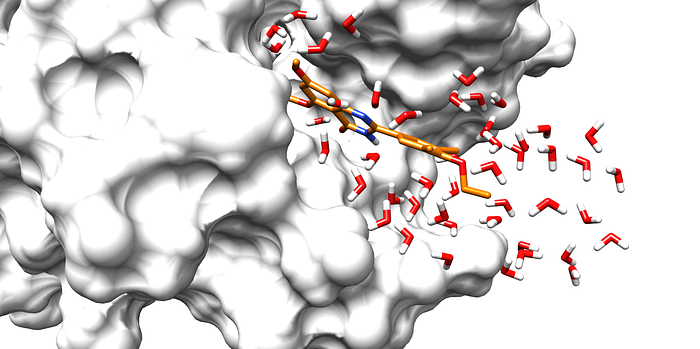
The image represents a protein with a ligand (in yellow and blue) and water molecules (in red and white).

Computational methods for understanding protein hydration have significantly advanced alongside experimental approaches, saving time and reducing costs, facilitating drug discovery processes. Moreover, in most cases, computational techniques can provide a better view of the structure and dynamics of the system than experimental setups. The reason is that crowded areas and inner cavities in a protein require very high resolution, while X-ray crystallographic experiments can only provide limited information due to poor resolution.

Numerical computational techniques can be very helpful. They can be used to simulate the explicit presence and interaction of water molecules in a protein. However, these simulations are usually costly, and the time required to provide accurate predictions can be extremely long, mainly if the cavity under investigation is occluded enough.

An alternative approach is first finding the water density in the protein pockets and then extracting the water molecules’ position from the density.

However, the number of configurations — the different ways water molecules can be placed in a pocket — corresponding to a given density remains potentially extremely large for classical methods.

A hybrid quantum/classical algorithm to locate water molecules inside protein pockets
Quantum computing is nowadays a great source of hope to deal with problems that are too complex for classical computers. By leveraging the principles of quantum physics, quantum processing units can store loads of information simultaneously and perform exceptionally well in tackling problems with a large number of combinations. See examples in previous blogs here and here.

PASQAL, in collaboration with Qubit Pharmaceuticals, is developing a hybrid quantum/classical approach that uses a classical algorithm to find the water density information in the protein and then a quantum algorithm to locate the water molecules inside any pocket, even in the buried ones. The collaboration will implement this quantum/classical water placement algorithm in a PASQAL quantum device.

Experimental test on Fresnel, a PASQAL commercial quantum processing unit
Scientists at PASQAL successfully tested a preliminary version of the novel quantum water placement algorithm on Fresnel 1, the first PASQAL industrial neutral atoms quantum computer. For this proof of concept, the scientists used the Major UrinaryProtein-1 (MUP-1), a protein produced predominantly from the liver. Evidence shows that this protein plays a major role in communication through pheromones, and in regulating energy expenditure and metabolism.

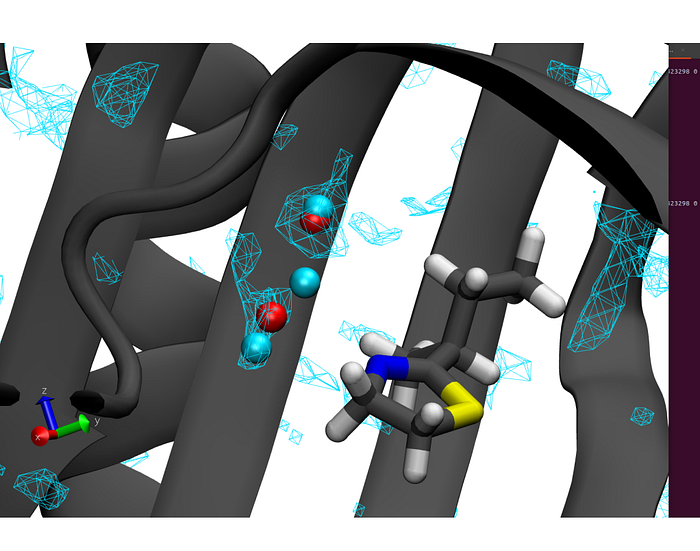
A pocket in the Major urinary protein-1 (MUP-1) is represented by the ribbons in gray, waters are in red and light blue, and the ligand is the small molecule in white, gray, yellow, and dark blue.

The following figure shows that the experimental results (on the right) are in agreement with the theoretical predictions emulations (on the left). Each figure represents a 2D slice in the protein pocket where the yellow shade represents the water placement.

The plots on the left represent the experimental values, while the plots on the right represent the values obtained from a classical simulation.

This successful result indicates that meaningful solutions to the water placement problem can be obtained using neutral atom devices, such as PASQAL’s. A preprint with these results has been recently published in the arxiv. This is the first time such an experiment has been conducted with the use of a real quantum computer, showing the capacity of quantum technologies to contribute to advancing healthcare problems. The full version of the PASQAL water placement algorithm will be implemented on the next-generation neutral atom machine that will be operating with 1000 qubits.

A quantum algorithm to accelerate drug discovery explained
PASQAL quantum algorithm uses the density of water inside the protein pockets, which is calculated with a classical computer using a method called 3D Reference Interaction Site Model (3D-RISM). The3D-RISM algorithm produces a probability distribution of densities, which is sort of a continuous and structureless pattern, like blur stains on a piece of paper. The question is, how do we extract the position of each water molecule from that messy output?

Density of waters in a protein pocket.

For this task, PASQAL and Qubit Pharmaceuticals have created a quantum algorithm that will start with the opposite question: if we propose a distribution of waters, does it reproduce the density map given by the 3D Reference Interaction Site Model?

The first step is to guess the positions of the water molecules assuming high water density places, each position with a probability distribution. In other words, we “smear” them so that they look like a blurry, spread-out continuous distribution. Then compare these blurry configurations with the output provided by the 3D Reference Interaction Site Model using a quantity representing a “distance.” The idea is to produce as many combinations as possible to find the minimal “distance” between these two density patterns.

To minimize this distance, we use the fact that, in real life, the water molecules are interacting, creating networks through hydrogen bonds, and that there is a minimal physical distance between each other.

PASQAL quantum method is inspired by the best classical software created for this job called Gasol. However, Gasol assigns a penalty included artificially to configurations where two water molecules would be placed too close to each other. This constraint is naturally implemented with neutral atoms architectures, let’s see how.

Neutral atoms quantum devices use highly focused lasers, so-called optical tweezers, to trap and manipulate neutral atoms individually to create 1D, 2D, and 3D arrays in arbitrary configurations. In these architectures, each qubit is represented by a two-level atomic energy state, usually a ground state and a Rydberg state, a very high energy state. In the Rydberg state, atoms are polarized, inducing van der Waals’ interactions between them.

This Van der Waals-type interaction between the atoms forbids two atoms to be in the Rydberg state simultaneously, if they are too close to each other, a phenomenon called Rydberg blockade.

In the experiment conducted on Fresnel 1, we used 2D arrays of rubidium atoms in the Rydberg state to represent the position and probability distribution of water molecules inside a protein pocket, using the Rydberg blockade as a natural way to keep waters being too close to each other during the simulation.

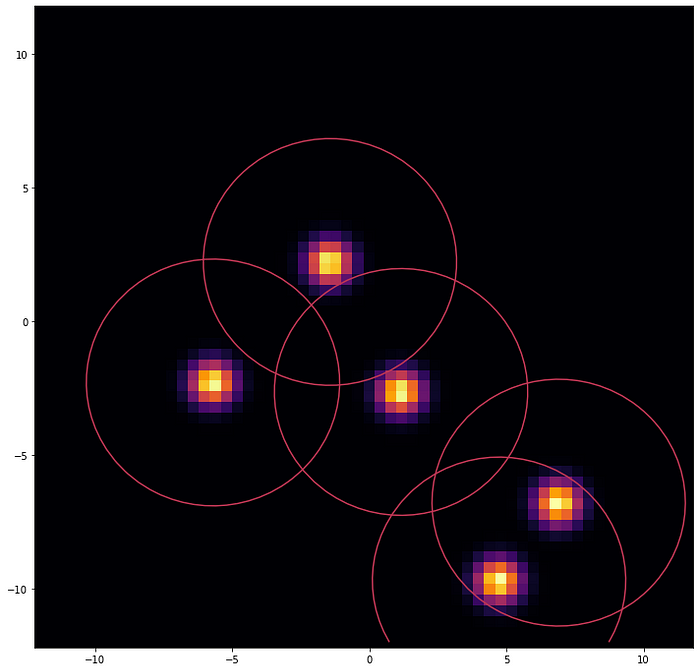
An example of a proposed water placement. Each qubit (dot in the image) represents a water site with its Gaussian distributions (circles).

‍The future of quantum computer-aided drug design
Much of a drug discovery project’s efforts are put in identifying and studying the pocket to find and optimize a drug with high affinity to the protein target.

Despite several successes, it is still extraordinarily difficult to predict binding affinity between a protein and a ligand. The ability to design novel ligands at will that inhibit the action of harmful biomolecules remains one of the major challenges in contemporary health sciences. The successful implementation of a quantum algorithm that helps tackle protein ligand affinity would represent a tremendous step further toward improving our quality of life.

References
D’Arcangelo,M., Loco, D., Fresnel team, et al. (2023). Leveraging Analog Quantum Computing with Neutral Atoms for Solvent Configuration Prediction in Drug Discovery. Preprint available here: https://arxiv.org/abs/2309.12129.
Henriet, L. et al. (2020). Quantum computing with neutral atoms. Quantum, 4, 327.
Samways, M. L. et al. (2021).Water molecules at protein–drug interfaces: computational prediction and analysis methods. Chem. Soc. Rev., 50(16), 9104–9120.
Bucher, D. et al.(2018). Shedding Light on Important Waters for Drug Design: Simulations versus Grid-Based Methods. J. Chem. Inf. Model., 58(3), 692–699.
Wlodawer, A. et al. (2008). Protein crystallography for non-crystallographers, or how to get the best (but not more) from published macromolecular structures. FEBS J., 275(1), 1–21.
Michel, J. et al.(2009). Prediction of the Water Content in Protein Binding Sites. J. Phys. Chem. B,113(40), 13337–13346.
Baron, R. et al.(2010). Water in Cavity−Ligand Recognition. J. Am. Chem. Soc.,132(34), 12091–12097.
Fusani, L. et al.(2018). Optimal water networks in protein cavities with GAsol and 3D-RISM. Bioinformatics,34(11), 1947–1948.

The full water placement inside proteins project will be funded by the Quantum for Bio program. Launched in spring 2023 by Wellcome Leap, an offshoot of the Wellcome Trust, the Quantum for Bio program aims to accelerate the use of quantum computing in healthcare by developing applications that will benefit from the arrival of quantum computers within 3–5years.
Would you like to learn more about these techniques on a neutral atom quantum computer? Get familiar with quantum computing, our platform, and algorithms with Quantum Discovery.

The start-up deluge

0

There is an increasing feeling that we are short on new ideas to tackle the emergencies of our time: climate change, cancer and neurodegenerative diseases, shortage of resources of all kinds (starting with drinkable water), potential upcoming pandemics, and so on. Indeed, some studies show that papers and patents are becoming less disruptive over time, which means that patents and scientific publications are built on previous knowledge rather than proposing new solutions.

Therefore, there is a focus on academic research as a source of new solutions, where new ideas are tested more likely than in an industrial setting. Why is that? The industrial sector has moved its interest from research and development to the commercialization of technologies developed elsewhere.

As a consequence, it is hard to witness iconic innovations like in the past, when, for instance, AT&T’s Bell Labs achieved eight Nobel Prizes for inventions like the transistor, the discovery of cosmic background radiation, or IBM itself in the software industry. 

In the biopharmaceutical industry, small and medium-sized enterprises (SMEs) and universities have become more and more important in generating new medicines and as sources of pharmaceutical innovation. High-tech SMEs come from academic institutions or incubators and rely heavily on the output of academic research. Some of the most important recent therapeutics and vaccines did not emerge directly from large drug companies; they were instead acquired through asset licensing, buy-outs of biotech firms, or came from publicly funded academic spin-offs.

Furthermore, SMEs play a pivotal role as innovation sources in high-priority areas related to public health, such as antimicrobial research and development. This has been highlighted in the COVID-19 pandemic, with crucial vaccines and drugs identified by academic institutions and/or SMEs, and developed through partnerships with larger biopharmaceutical companies (Moderna and the Pfizer-BioNTech alliance, both heavily supported by the US government through Operation War Speed). As evidence of this tendency, research published in Nature in 2022  found that 38% of the innovative treatments approved between 2010 and 2019 by the European Medicines Agency (EMA) were originated at SMEs or public institutions, and academia and/or SMEs were at the origin of approximately 47% of new product transfers.

In conclusion, the willingness of large firms to invest in scientific capability has declined and they concentrate their R&D efforts on the later stages of development, rather than on basic research.

Why do corporations bet more and more on academic research and on SMEs than on internal research? A study suggests that corporate research, and the large corporate labs in particular, fell out of favor with investors and, eventually, also with managers. The focus shifted to university research and startups, often venture-funded, that aimed to capitalize on the scientific and technical advances in university labs. According to this analysis, corporations turned to sourcing ideas and inventions from the outside, hoping to combine them with their downstream development and commercialization abilities. Therefore, at least in the biopharma sector, big pharma has become, instead of hardcore drug developers, ultra-rich venture capitalists focusing almost exclusively on regulatory phases, production, commercialization (don’t forget marketing) and building their pipelines based on what is known as mergers and acquisitions (M&A): they pinpoint promising companies with products (approved or under development) and just buy them. The prices paid on these M&As can be just delusional.

All in all, innovative solutions to our modern (huge) problems will likely come from public research, being COVID-19 vaccines one good example.

For some reason, which I admit I ignore, there is a wide consensus around the world that one of the preferred ways to transform research into technologies is by the creation of start-ups. Turning a start-up into a profitable company is a long, perilous, investment/labor-intensive, and highly uncertain process. 

A brief explanation of how academic start-ups are typically created will allow us to understand what is at stake. 

When a research project from an academic team is considered mature enough – there is a long list of shades on what mature means, a topic itself for the stand-alone article – the researcher that leads that project (or a member of his/her team) will create a company to further mature the technology and take it to the market (or sell it to someone else in an M&A). Typically, universities own a big chunk of the intellectual property related to these technologies therefore the university grants the researcher (or whoever wants to use the technology) an exclusive license. That licensing from the university to another party is the foundational event of a start-up. Universities and governments invest a lot of money in supporting this licensing and also nurturing and incubating ing these new-branded companies. These newly created entities can be incubated in the same research institutes where the research was done (with their typical set of conflicts of interests) or elsewhere (public or private incubators, other universities, etc.).

Does it make sense to focus so much on creating start-ups? Is the standard way of creating start-ups reasonable (there are golden rules that everybody is trying to follow more or less accurately)? I do not have the answer to any of these questions. Another question for which I do not have an answer either, but whose answer could be found in the statistics: what is the success rate of academic biotech start-ups? Maybe answering this question will shed some light on the other ones.

At least from a standard Google search, the first result of start-up statistics is that there are only very few. There is no official historical record in the US or Europe of start-ups, neither of their trajectories, successes, or failures. To the best of my knowledge, only one available report systematically addressed the number of university−licensed life science startups (i.e. firms producing products and/or services in biopharma, medical devices, or traditional pharma) and their success (or failure) for the 1980-2013 period. It was done for the top 50 US universities, in terms of the number of patents granted.

The report has some interesting findings. First, from 1990 to 2011, there was a steady increase in start-ups that never had business activity. Another bunch of them had some business activity but never had more than two employees (which the authors name ”Walking Dead”). 

Second, the authors try to tackle the never-ending question of whether start-ups as a whole generate more money than the money they cost. Conclusion: ”Just under 90% (89.76%) of the e university−licensed startups in our sample never operated as public companies and did not report revenues, expenses, direct labor costs or direct taxes paid; hence, a full economic impact analysis exceeds our grasp”. Becoming a public company (i.e. operating in the stock change market) is a rather rare event in biotech start-ups, and those that stay private, depending on the geographic location, oftentimes do not make their books of account public. 

Even though the existence of the walking dead is, in theory, avoidable and, again in theory, not inherent to the process of start-up creation, I think it points to a current phenomenon in the creation of start-ups. We assume that more is better, so one indicator to measure the success of innovation ecosystems and universities’ knowledge transfer offices is the number of start-ups created; there are of course many nuances to this single number (in some places the number of start-ups is broken down to active ones, etc). For obvious reasons, just counting new start-ups as a proxy of success is a strategy full of flaws, starting with the fact that you can create lots of walking dead. But even if we forget about counting start-ups, how can we measure if new start-ups are successful? More fundamentally, what does it mean, to be a successful start-up?

The answer to the last question is pretty straightforward: value created, whether economically (jobs created, profit margin) or, most importantly, in terms of solutions to a medical need. Those numbers are rather easily measured at the single start-up level, assuming that you can check the balance sheet of the company. 

By Anne-Louis Girodet de Roussy-Trioson – Oakenchips, Public Domain, https://commons.wikimedia.org/w/index.php?curid=30694833

But what happens when we zoom out at the regional/national/global level?

In that case, there will be lots of walking dead. Some take off but then crash, and some, just a handful, will hit the jackpot, meaning that they will create new products successful in the market. The question is the following: do the successful ones justify the existence of the others? That question tends to be biased by anecdotic cases such as flaming successes. Let’s consider two well-known examples of those: Biontech and Moderna. Both companies are behind the mRNA-based vaccines that allowed us to put an end, for the time being, to the Coronavirus pandemic. The truth is that, before the pandemic, both companies were using their technologies to treat solid tumors, and at the time, it was an open question if they were going to survive in the mid-term. Indeed, both are still struggling to make significant progress on their clinical programs focused on mRNA-based vaccines for cancer treatment. 

It might be argued that indeed the current model, which creates a lot of start-ups to find the successful ones, does work. New treatments are approved every year and economic value is being created.

The first part of that answer belongs to a very complicated discussion. Pharma will by default claim that we are making progress and that is just too complex to treat some diseases, which is why it takes so much time and money. That is a fair statement, but I think it should not be considered as an argument to consider other approaches that might be more fair and effective for patients, even if not so much for shareholders. A recent report has estimated that $50 to $60 billion is spent annually on failed oncology trials. There are, of course, many potential routes to make this picture better. There is one that is particularly provocative: what if, to improve the survival of patients suffering from serious diseases, diagnostics, early detection, and lifestyle are more important than therapy? If that is the case, then there are way too many companies, start-ups included, working on new treatments. The trick is that working on those approaches does not have a strong business model, although some new business model paradigms supporting these alternatives to classical drug development have begun to emerge.

So,  it is difficult to determine the efficiency of start-ups on a global scale. But some people are nevertheless making money: venture capitalists make returns that justify their existence and big pharma acquires former start-ups through mergers and acquisitions, which makes pharma increase their value. The billion-dollar questions are: do start-ups as a whole create more value than the money they cost? If not, who is paying for that difference? The second question has a very obvious response: taxpayers. 

There is a third and very disturbing question, which might lead to an answer to the previous ones. Academic start-ups, as explained above, are based on scientific discoveries from research labs. These discoveries can lead to treatments in very different ways, the creation of a start-up is just one of them. Discoveries can be used by companies via licenses or collaborations with the scientists at the origin of these findings. Academic teams, through public structures, can further develop these technologies. All of these options have pros and cons, the creation of start-ups included. Indeed, thinking of start-up creation as a one-size-fits-all solution to translate scientific discoveries might be a good choice in some cases, but not a wise decision in many others. So the question is: are we using scientific discoveries to develop new solutions wisely by creating so many start-ups? 

I think that new ways of using science to solve society’s problems should be built, not based on market needs but on their potential to provide these solutions. These new models will have to be judged not in terms of economic benefit, but in terms of the impact of the solutions they bring. 

Picture: By Anne-Louis Girodet de Roussy-Trioson – Oakenchips, Public Domain, https://commons.wikimedia.org/w/index.php?curid=30694833

What Will It Take to Build the World’s Biggest Radio Telescope Observatory

0

The SKA  (Square Kilometre Array) Radio Telescope Observatory — planned to be the largest radio astronomy facility on the planet — has begun construction after 30 years in the planning stages. This mammoth project comprises two radio telescopes, one in South Africa and the other in Australia. It would be a global observatory operating two telescopes across three continents. 

The SKAO is a next-generation radio astronomy-driven Big Data facility with the aim to unlock and go deeper into the understanding of the universe and the laws of fundamental physics.  Building these enormous radio facilities is just phase one of the grand plan. By using the SKOA, scientists hope to learn more about early star formation. How can radio telescopes help them in their studies?

The SKA Radio Telescopes

Conceived at the beginning of the 2000’s millennium, it’s taken the Australian and South African governments a long journey of cooperation to reach this point. The SKA Radio Telescope Observatory will likely be operational in a few years. Some of the scientific operators will still need several years to be ready. However, once completed, the array is poised to give astronomers insight into the universe more significantly than any other radio telescope facility before it.

The SKAO will be one global observatory operating two telescopes across three continents. Currently, 16 countries from all over the world take part in the project. Similar to how optical telescopes collect and enhance light to get detailed images, radio telescopes improve radio waves to allow astronomers to analyze them. Radio waves can provide scientists with much more information about stars, galaxies and other astronomical objects than observed using only visual data.

Specifications and Applications

The SKA Radio Telescope Observatory will integrate two main facilities — the Murchison Radio Observatory in Western Australia and the Karoo Astronomy Reserve in South Africa. Murchison Radio Observatory will be home to the SKA1-LOW telescope. This telescope is designed to observe radio waves in the range of 50-350MHz.

Its primary purpose is to observe the Epoch of Reionization — the period in cosmic history when the stars first formed. To accomplish this, SKA1-LOW will consist of phased dipole antenna stations separated by 65km. This is the optimal configuration for observing low-frequency radio waves.

The Karoo Astronomy Reserve will be home to the SKA1-MID. The design of this telescope allows it to support radio receivers that can capture frequencies of up to 20 GHz. To achieve this, SKA1-MID will utilize 197 dish antennas spread over a 100 km range.

The wide range of frequencies accessible with this telescope will address various fundamental scientific areas — including the reconstruction of gravitational waves using high-precision pulsar timing. The range of the SKA1-MID is so great that it can also look for traces of life on other planets.

Prototype antennas for the SKA-Low telescope being installed at the Murchison Radio-Astronomy Observatory (MRO) in Australia. Credit: ICRAR. https://www.skao.int/en/media

Challenges and Timeline

Both telescope’s construction began on December 5 in 2022 The first building project is Array Assembly 0.5, made of six SKA-LOW antenna stations and four SKA-MID dishes. Construction is set to finish by early 2024.

Once work on Array Assembly 0.5 is completed, the raising of Array Assembly 1 will begin.  It will comprise 18 SKA-LOW stations and eight SKA-MID dishes. It will be completed by 2026. Early 2027 will see Array Assembly 2 finished, which contains  64 SKA-LOW stations and 64 SKA-MID dishes.

All the installations are expected to be ready — and the facility for scientific operations — by 2028–2029. However, the SKA Radio Telescope Observatory faces many challenges. One of the primary drawbacks of radio telescopes is the possibility of radio interference. It makes images unclear and limits the number of observable radio waves.

Natural factors generate radio interference, but the most significant sources are aircraft systems and satellites. Satellites pose a complex problem for radio telescopes, as the waves they broadcast create a layer of interference that gets thicker as companies add more.

In particular, this interference will significantly affect SKA-MID since its range of observation covers up to 20 GHz — the same or close to the frequency most satellites operate on.

However, the SKA observatory members have stated they are more than up to the challenge. 

Both telescopes were built in locations designated as national radio-quiet zones. These sites will allow the telescopes to maximize the range of observations while considering radio interference from satellites and other sources. Furthermore, SKA-LOW and SKA-MID ensure there is little to no radio interference generated from the telescopes.

Construction of the SKA Radio Telescope Observatory continues, and the future of radio astronomy looks bright. The largest and most advanced radio observatory is poised to give scientists a greater understanding of the universe and its workings than ever before.

References.

Scaife, A. M. M. (2020). Big telescope, big data: towards exascale with the Square Kilometre Array. Philosophical Transactions of the Royal Society A, 378(2166), 20190060. https://doi.org/10.1098/rsta.2019.0060

Explore | SKAO. (n.d.). https://www.skao.int/en
Newton, E. (2023, March 28). Making Up the Universe: What Are Cosmic Objects? Revolutionized. https://revolutionized.com/cosmic-objects/

Cooper, K. (2023). SKA Observatory (SKAO): A guide to the soon-to-be largest radio telescopes in the world. Space.com. https://www.space.com/square-kilometre-array-observatory-skao#section-when-will-the-ska-telescopes-become-operational
Foust, J. (2023). Radio telescope faces “extremely concerning” threat from satellite constellations. SpaceNews. https://spacenews.com/radio-telescope-faces-extremely-concerning-threat-from-satellite-constellations/

Images credit: SKAO. https://www.skao.int/en/media

How Instagram Reels impact users’ mental health

A couple of months earlier this year, the Times of India reported that two young boys in India were accused of killing a 31-year-old woman while riding a bike while filming Instagram Reels. Another story, featured by Express.co.uk, reported that a young lady from Congo. 16 years old, strangled to death while participating in the Tiktok surf game challenge on Instagram Live. 

These two unfortunate incidents are alarming examples of how the young generation goes through a great deal of pressure to be constantly presentable and popular on social media platforms. The issue isn’t just the people who are following Instagram Reels trends. It’s also about individuals who are watching this content repeatedly and growing weary of the never-ending lingo used on social media.
The results are despair, low self-esteem, and distraction.

Impact of Instagram Reels on Mental Health

According to a study “Does Smartphone Addiction, Social Media Addiction, and/or Internet Game Addiction Affect Adolescents’ Interpersonal Interactions?” by Yang et al., published in the MDPI Open Access Journal, wide-spread use of multi-functional smartphones has increased screen time and decreased real-life interpersonal interactions. 

Due to the excessive use of smartphones, adolescents and young adults waste a significant amount of time staring at screens, resulting in negligible face-to-face interactions. They mostly have reel friends rather than real friends, making them suffer from social disconnectedness. The dearth of real friends compels them to follow Instagram Reels trends, get virtual attention and popularity, and engage in others’ reels.  

Another paper published in the International Journal of Environmental Research and Public Health emphasized the fear of missing out (FOMO), as a vital factor behind their inclination towards reels. A constant phobia of falling behind the current trend drives the young generation to make captivating reels. The consequences of this are such tragic incidents. 

Reports published by Social Media and Youth Mental Health: The U.S. Surgeon General’s Advisory in 2023 highlighted the influence of social media on the mental health of youth. The report said that the impact of social media on mental health is shaped by several complex factors, including but not limited to the total amount of time spent on these platforms, the type of content they consume or are exposed to, the interactions and activities social media affords, the sleep cycle, and physical activity. It is important to note that social media affects adolescents differently based on their individual strengths and vulnerabilities and also based on their socio-economic backgrounds. 

One of the vital stages of brain development occurs between 10-19 years old. During this age, risk behaviors increase, and well-being experiences fluctuate. Also, mental health issues like depression emerge. Frequent use of social media is associated with distinct changes in the amygdala (important for emotional learning and behavior) and prefrontal cortex of the brain (used for impulse control, moderating social behavior, and emotional regulation). As a consequence, adolescents might experience heightened emotional sensitivity to communication, a decrease in life satisfaction, and the subsequent development of depression.

A longitudinal cohort study conducted by Riehm et al. in 2019 over U.S. adolescents aged 12 to 15 years showed that spending more than 3 hours on social media doubles the risk of developing depression and anxiety. Another study conducted by Braghieri et al. in 2022  with US college students also showed a significant increase in depression symptoms upon the introduction of social media platforms.  

Distribution of Instagram users worldwide as of January 2023, by age group

Created with Highcharts 7.2.2Percentage of users8%8%30.8%30.8%30.3%30.3%15.7%15.7%8.4%8.4%4.3%4.3%2.6%2.6%13-1725-3445-5465+18-2435-4455-64
0%5%10%15%20%25%30%35%
55-64
• 4.3%

Source: Statista.com

Remedy 

Cutting back on the use of social media is the only way to escape from this vicious cycle of Instagram Reels. Allcott et al. 2020 study showed that the deactivation of social media for four weeks improved the subjective well-being of the participants. They recommended further group-based training and other psychological interventions to improve the mental health condition. 

Conclusion
In the United States, nearly all teenagers and young adults are on social media, yet there isn’t enough evidence about how seriously social media affects mental health. These young people have, unknowingly, made themselves the subjects of decades-long experiments. Therefore, it is crucial for the researcher to conduct further investigations to study the influence of social media on the development of depression and formulate measures to prevent it.

What are Reels?
Reels are basically small video clips on social media platforms such as Instagram, YouTube, and Facebook. Initially, the maximum runtime of the reels was 30 seconds, which was later extended to 90 seconds. Instagram Chief, Adam Mosse, in his latest article, responded to the illusive ranking algorithm of Instagram. According to Mosseri, last year, the platform emphasized the reach of Instagram Reels over traditional photos. Currently, the company is trying to re-establish a fair balance between the reach of both the pictures and reels. However, the damage has already been done, and a significant percentage of young adults are now reel-addicted. According to the reports published by Statista, India and the United States have the largest Instagram users, with nearly 330 million and 143 million, respectively. A vast majority of the users are 18 to 34 years old.
Factors influencing Instagram reel usage
A study published in Telematics and Informatics Reports highlighted seven different motivational factors behind the usage of Instagram reels. These seven motivational factors include self-promotion, social rewards, escape from reality, entertainment, surveillance over others, documentation of self-achievements, novelty, and staying  active to trends. Narcissists exhibit higher usage of Instagram Reels trends for socially rewarding self-promotion and  entertainment purposes, whereas escapist users showcase higher consumption along with participation behavior. Entertainment seekers produce more videos for self-entertainment. 

References

The Verge. (2022). Instagram showed people too many videos last year, admits Adam Mosseri. Available at: https://www.theverge.com/2023/1/20/23564321/instagram-reels-photos-adam-mosseri-too-many-videos

Statista. (2023). Instagram – Statistics & Facts. Available at: Instagram – Statistics & Facts | Statista

Yang, S. Y., Wang, Y. C., Lee, Y. C., Lin, Y. L., Hsieh, P. L., & Lin, P. H. (2022, May). Does smartphone addiction, social media addiction, and/or internet game addiction affect adolescents’ interpersonal interactions? In Healthcare (Vol. 10, No. 5, p. 963). MDPI. https://doi.org/10.3390/healthcare10050963

Koinig, I. (2022). Picturing Mental Health on Instagram: Insights from a Quantitative Study Using Different Content Formats. International Journal of Environmental Research and Public Health, 19(3), 1608. doi: 10.3390/ijerph19031608

The U.S. Surgeon General’s Advisory. (2023). Social Media and Youth Mental Health. Available at: https://www.hhs.gov/sites/default/files/sg-youth-mental-health-social-media-advisory.pdf

Fuhrmann, D., Knoll, L. J., & Blakemore, S. J. (2015). Adolescence as a Sensitive Period of Brain Development. Trends in Cognitive Sciences, 19(10), 558–566. https://doi.org/10.1016/j. tics.2015.07.008

National Academies of Sciences, Engineering, and Medicine (NASEM). (2019). The Promise of Adolescence: Realizing Opportunity for All Youth. Washington, DC: The National Academies Press. https://doi.org/10.17226/25388

Orben, A., Przybylski, A. K., Blakemore, S. J., & Kievit, R. A. (2022). Windows of developmental sensitivity to social media. Nature Communications, 13(1), 1649. https://doi.org/10.1038/ s41467-022-29296-3 18. 

Riehm, K. E., Feder, K. A., Tormohlen, K. N., Crum, R. M., Young, A. S., Green, K. M., Pacek, L. R., La Flair, L. N., & Mojtabai, R. (2019). Associations Between Time Spent Using Social Media and Internalizing and Externalizing Problems Among US Youth. JAMA Psychiatry, 76(12), 1266–1273. https://doi.org/10.1001/ jamapsychiatry.2019.2325

Braghieri, L., Levy, R., & Makarin, A. (2022). Social Media and Mental Health. American Economic Review, 112(11), 3660-3693. https://pubs.aeaweb.org/doi/abs/10.1257/aer.20211218

Allcott, H., Braghieri, L., Eichmeyer, S., & Gentzkow, M. (2020). The Welfare Effects of Social Media. American Economic Review, 110(3), 10.1257/aer.20190658 

The Time of India. (2023, March). Duo recording Insta reel on motorcycle ends up killing woman. Available at: Duo recording Insta reel on motorcycle ends up killing woman in Maharashtra | Pune News – Times of India (indiatimes.com)

Express UK. (2023, June). 16-year-old girl dies attempting TikTok ‘scarf game’ challenge. Available at: 16-year-old girl dies attempting TikTok ‘scarf game’ challenge | World | News | Express.co.uk

Image Marjan Grabowski on Unsplash

The Scientist’s journey from academia to industry – A User’s guide (Part 3)

0

I discussed in two previous articles the first steps in the process of moving from academia to industry. The first article was about taking the decision to leave academia and finding purpose in a new professional life. The second article,  provided some tips to find and apply for new jobs outside academia. 

In this third and last piece, I will consider the exchange and negotiation with a potential employer during the recruitment process. So you applied for that job you found interesting. After a couple of days/weeks, you get an email with an invitation to discuss with the employer. First reaction: Yes, I made it! Second reaction: Omg,  now what? 

The aim of the game

Your first reaction is fair. So far, you made a good job. Your CV and cover letters were good enough to get their attention and your skills and experience triggered their curiosity. Thus, they want to know more.

Your second reaction might be a bit over-dimensioned. This new exchange, as this whole process, is an exploration for both sides. The aim is to find out if you, the job, and the employer are a good match. It is not about if you are good or not as a professional. There is a suitable job for you, the trick is to figure out which one is it. One of the best ways to sort that out is to apply for jobs and go through the recruitment process. This is only half of the story. The other half is that, unavoidably, you will know if there is a match or not by doing the job. That is a risk both sides (you and the employer) have to be aware of. The entire recruitment process aims to reduce the chances of seeing a match where there’s none or a weak match that will not survive with time. Do not forget: during the recruitment process both parties are evaluating each other.

Golden rule: stay always open to the possibility that this is not the right job for you. Again, the main purpose of the whole process is about understanding if you and the employer are a reasonably good match, not to convince the employer that they should hire you. Of course, you have to convey that, but only to have the ball on your side: This is why you should hire me, why should I accept your offer? If you focus too much on getting the job no matter what, you will not see the signals that might tell you that you should walk out of the room the same way you entered it. Trust me on this one, like in any other relationship, the best favor you can do to yourself is to turn down a bad offer if you can do so.

Loading your weapons for the hunt

Once a potential employer shows interest in your profile, typically he/she will offer you a phone call (very rare these days), a video call, or an interview on-site. It never happened to me to have a call out of the blue to discuss a job application without previously fixing an appointment. Refusing the discussion and asking to fix an appointment is fair but might be seen as a lack of confidence on your side. It’s your choice. In any case, I would see that as a yellow flag. They can do such things for many different reasons, but I only can think negatively about all of them, such as they are putting you willingly in an uncomfortable situation to see how you react, they do not have a clear plan for the recruitment process, they do not take enough time to evaluate candidates, they do not care too much about your profile.

In the case the first contact is to fix an appointment, there are three things you have to do before the interview: prepare, prepare, and prepare. Preparation will simply increase your chances of having a successful interview. Other than preparation you can rely on your innate improvisation skills or mere luck. Why preparation? Here is a non-exhaustive list of its advantages:

  • It will increase your confidence (interviewers can smell fear better than dogs).
  • You will be aware of your strengths and weaknesses, and those of your potential employer.
  • It will provide you with good and pertinent ideas for questions, avoiding nonsense questions (AKA what is a typical day on this job?).
  • Interviewers will see that you are prepared and that will mark for you only positive points: you are responsible and organized, you take this application seriously, you can do proper due diligence, etc.
  • And most importantly, it will help you understand if the job is a good match for you and, if you have the opportunity, increase your chances to make the right choice.

How to prepare? Another list of non-exhaustive tools:

  • Do not read the employer’s website, scan it at the atomic level. You will have read it enough once you have a feeling of where the company is standing and where it is heading to. The news sections are really useful to grasp that. Public companies have to publicize their financial balances and plans for the shareholders. These files can be (indeed are) quite boring to read but these companies also make a summary of the last period and the plans for the next one. Those are precious pieces of information to understand the context of your potential new job. 
  • Again and again, Linkedin. Check the company’s Linkedin profiles, oftentimes the presentation of the company is easier to understand than that on the company’s website. Also check the profiles of your interviewers: how long they have been working for the company? Have they been recently promoted? What is their education? Do you have contacts in common?
  • If applicable, read the recent scientific publications of the company related to the job and/or your interviewers. 
  • Read whatever you can find on social media and on the internet about the company and your interviewers.
  • Talk to people from your network that work or have worked for the company and/or on similar jobs to the one you are discussing. 

All this information will give you a fairly good idea of what the job is about and where it fits concerning the rest of the company. All in all, by now you should have a more or less clear idea if you and the job are a good fit. Besides that, you significantly decreased the chances to have a bad surprise during the interview (which is never zero).

Asking the right questions.

All this preparation will help you to have a list of questions for the interview. 

Advice: think of your questions as something other than a box to be ticked. Above all, do not think of them as something to show to your interviewers. Use them as a way to understand what the job is about and if you match with the company. Very importantly, make challenging questions: what is the financial situation of the company? What is your selling point concerning the competitors? What are your plans for the next five years? Ask about anything you find uncertain during your research. If it is a good place to work a good discussion will follow. If they take those questions personally, it is not a good sign as it might well indicate they can not deal with criticism and bad news, which for companies are true poisons.

Avoid vague questions that allow any answers – what is a typical day for this job? What are your biggest challenges?-. They sound like you are killing time. If you properly did your homework you should be able to make more precise questions. A pretty good indication you did good homework is that, during the interview, they explain to you a lot of things you already know. Be careful, do not interrupt them to say ”I know that”. This will sound pretentious and disrespectful. 

Preparing your pitch

Unavoidably, the first question you will have during the interview is: Can you tell me about yourself? That is the most important part of the interview. You will show if you can tell a coherent story of your background which is relevant in the context of the job and the company, and also your communication skills.

To answer successfully to this question, a good thing to do is to prepare a pitch of no more than three minutes (according to a stop-watch). It should be a short version of your cover letter: who you are, what is your motivation, and why you and the job are a good match. Repeat it until you can say it almost by heart. Use friends or colleagues as sparrings, record it, everything is allowed.

The interview day

Being a bit nervous is fine, but not to panic.
Whether the interview is online or on-site, be ready half an hour in advance, that will allow you to double-check and feel more confident. During the interview, do not forget that they are on the lead of the discussion. Let them start and do not interrupt. 

Take notes. You will get a lot of information that will be useful to evaluate things on your side and to prepare potential follow-up discussions. Be brief in your answers and to the point. That shows that you can communicate properly and build logical ideas. Do not lie, never. If you don’t know the answer just say it. If the answer to their questions is not what they expect, look for a polite way of phrasing your answer.

Give concrete examples to support your claims about your background, always. That will show you are not making things up and will help your interviewers understand what exactly your experience is. Do not hide the black spots of your job experience, look for a way to explain that. Although it was not a great moment, it happened for a good reason and explain what you learned from that.

If possible, try to speak positively. If you are explaining why you are looking for a new job, do not spend time criticizing your current boss or employer; without overlooking the things that are not optimal in your current job. Focus on what is your driver for the future and how this current job opportunity it is a great door to the path you want to pursue.

End your part of the interview with this question: how the procedure continues from now? That is an important question because it will force your interviewer to explain the process and the timelines. Take notes of their answer. Some interviews give you a great feeling, some others make you feel you did all wrong. In any case, once the interview is over, try not to think about that (especially in the second case). Take some distance from what was just discussed, and close it in a friendly and gentle way. You will have the days after the interview to properly reflect on what happened.

After the interview

Once you walk out of the room/video call, start reflecting on what just happened: are you happy with your performance? What are the things you did great/well/just ok/terribly wrong? Also evaluate your interviewer: what was their attitude? Were their answers clear? Do they know what they want for the job and the company? If you feel too troubled or confused is alright to talk to someone you know that is well-positioned to evaluate your concerns and give you her/his point of view.

If, after the interview, you are still interested in the job, a good practice is to send an email to your interviewer thanking them for the opportunity, telling why you like the job (the aim is to show that you got their message and you understand what the job is about) and why you think you are a great fit. Do not wait more than two days to send that email.

And the winner is…

After the interview four things can happen:

  1. You do not get an answer. You deserve one, even if negative. I strongly believe it is disrespectful not to honor the time and effort you spend during the whole process. You can wait for one week to send an email to ask for news ( just two lines, there’s no message to deliver here). If you do not have an answer one week after that email, a phone call is the logical thing to do.
  2. You get a negative answer. Usually, it will come as an email that does not say much, something they send to all candidates that have not been taken. If this type of job is important for you, then is completely fair to ask for details about what was missing. If the interviewer takes candidates seriously, they should explain to you why. In any case, if you get that explanation, it will stay rather vague because they do not want to open angles you can contest.
  3. They will ask you for another interview. That is fine, as far as it is clear what is the purpose of this new interview. Are you going to meet the team or the boss? Is it to discuss contract details with human resources? Sometimes employers ask for more interviews for no clear reason, which is a yellow flag because it might indicate that there is something that does not convince them about you or they are winning time until they get a confirmation from another candidate. In both cases, they are wasting your time, and theirs.
  4. You get a positive answer, yeayyy!!! First of all, celebrate. Second, get ready to discuss the contract, but that is a topic not covered in this article.

This first job outside academia pretty likely will not be the last one. Pay attention to all the things that happen during the whole process from the moment you read the job description. The key is to take proper conclusions on the whole procedure and, if the moment comes, be better prepared for the next job.

Image Wikimedia Commons, is a repository of free content hosted by the Wikimedia Foundation.