Home Blog Page 38

Bringing ‘Dirty’ Mice Into Labs Opens A World Of Possibilities

The use of mice in biomedical research dates back to the 16th century, when William Harvey used them to study blood circulation. Ever since, no other animal has had such a great impact on scientific research. In fact, alongside rats, mice represent around 95% of animals used in laboratories around the world.
Until now, every single mouse used in laboratories went through a very meticulous process of handling and care in secured animal facilities. Strict international legislation state that mice have to be “provided with humane care and healthful conditions during their stay” in those facilities. Also, lab mice are usually subjected to a process of selective breeding to assure their genetic homogeneity, in order to make it possible to compare and replicate different experimental data.
On top of that, since they are kept in extremely sanitized facilities, lab mice are free from pathogens that commonly determine and shape human’s immunological system and therefore, are extremely susceptible to microorganism’s attacks. Thus, it is commonly accepted that, while mice might be the best models to study human diseases, they are far from accurately mimicking the human body environment. In particular, the differences between mice and human’s immune system are greatly significant.

Different immune systems

Intrigued by these differences in humans and mice’s immune systems, David Masopust and his team assessed the presence of memory T cells in both human and mice tissues. Memory T cells are a specialized subset of cells that keep a record of previous infections by microorganisms and act quickly to protect the body against a second infection. Thus, the higher the number of these specialized cells, the stronger the ability to fight infections.
The team concluded that, not surprisingly, adult human’s tissues were strongly populated with specialized immune cells. In contrast, they found that these cells were practically absent in lab mice’s tissues. Moreover, when comparing lab mice with newborn humans, Masopust concluded that their specialized T cell levels were quite similar, likely because both human babies and lab mice have little contact with pathogens in the environment.

“Dirty” cage-mates make “clean” mice stronger

Having proved that mice and human’s immune systems are indeed different, the next step was to understand whether those differences are intrinsic to all mice or specific to “pathogen-free” mice. To study this, Masopust decided to break the sacred rules of animal handling, by bringing wild mice into his lab and co-housing them with ‘clean’ lab mice.
After 8 weeks of co-housing, more than 20% of ‘clean’ mice died, because they were too weak to kill pathogens carried by wild ‘dirty’ mice. However, the co-housed mice who did survive quickly developed a strong immune system: the levels of specialized T cells were now much higher and, most importantly, co-housed mice were able to strongly fight infections, compared to the “clean” mice kept in sterilized cages.

[su_custom_gallery source=”media: 52870,52877″ link=”image” width=”370″ height=”350″]

Testing the “Hygiene Hypothesis”

Masopust’s study confirms that “it may be opportune to add ‘dirty’ mice to the repertoire of investigative tools” in laboratories, in order to “normalize” lab mice’s immune systems. Nevertheless, as many flaws as the current lab mice models might have, they are still irreplaceable tools for researchers. For instance, the process of breeding selection, that renders lab mice extremely susceptible to infections, is the key to achieve reproducibility and comparability of experimental results. And the logistics of bringing “dirty” animals into clean animal facilities are not easy. Masopust’s team had to request a special authorization to bring wild and pet-sore mice into their laboratory’s animal facilities.
The challenges of implementing “dirty” mice in laboratories are huge, but so are the possibilities. For now, Masopust’s team wants to use these mice to test the “hygiene” hypothesis: the idea that the increase in certain immune disorders, such as asthma, is the result of low environmental exposure to microorganisms during childhood. On the long run, they hope to create a better solution to translate mice studies’ results to human clinical trials. While other groups struggle to create alternatives to animal testing, Masopust’s studies show that laboratory mice are here to stay.


References
Beura, L., Hamilton, S., Bi, K., Schenkel, J., Odumade, O., Casey, K., Thompson, E., Fraser, K., Rosato, P., Filali-Mouhim, A., Sekaly, R., Jenkins, M., Vezys, V., Haining, W., Jameson, S., & Masopust, D. (2016). Normalizing the environment recapitulates adult human immune traits in laboratory mice Nature, 532 (7600), 512-516 DOI: 10.1038/nature17655
Mestas, J., & Hughes, C. (2004). Of Mice and Not Men: Differences between Mouse and Human Immunology The Journal of Immunology, 172 (5), 2731-2738 DOI: 10.4049/jimmunol.172.5.2731
Shultz, D. (2016). Can ‘dirty mice’ save animal research? Science DOI: 10.1126/science.aaf4153
Reardon, S. (2016). Dirty room-mates make lab mice more useful Nature, 532 (7599), 294-295 DOI: 10.1038/532294a
APA guidelines

A Glossary of Annoying Expressions In Science Communication

0

In response to my post “Where Have All The Bad Scientific Talks Gone?”, I’ve received a variety of feedback from readers who expressed exasperation about the way science and innovation are often discussed.
There are concerns that, in general, these areas are becoming overcrowded with growing levels of clichés and even nonsensical terms. Expressions that possibly echo delusions of grandeur, demonstrate the disconnection between what a person “thinks” and what is actually known, or simply conceal a disregard for evidence.
In these conversations, multiple instances of irritating expressions have been highlighted, which can be found in a wide range of media: from scientific publications and all kinds of meetings to official business communication and journalism. A selected glossary of such commonly used expressions follows.

‘I am not an expert, but…’

Common usage:  ‘I am not an expert, but I think you should…’, or variations of the sentence following ‘but’. This is an archetypal indicator of an incoming cloud of conceit, especially in meetings with a multi-disciplinary audience. However, it can be heard in different contexts and is not necessarily used by researchers only.
Likely origin: Some people’s need for constant validation.
Possible actual meanings: I am going to say something to justify my presence in this meeting, or alternatively: my opinion matters more than years of research or scientific consensus. Also used to avoid a proper argument or hide behind a screen of false modesty.

‘At the end of the day’

Common usage: ‘You know, at the end of the day…’, ‘I agree, but at the end of the day…’. This expression is also a major hit in tech transfer and entrepreneurial circles.
Likely origin: Anglo-American sport commentating and politics.
Possible actual meanings: I will ignore what everybody else has just said, and will try to politely impose my wishful thinking. Conversely, it may indicate that the user has just run out of ideas.
‘Shedding light’
Common usage:  This is not only a classic expression in science journalism, e.g., ‘Scientists shed light on…’, but also in research articles, e.g., ‘This study sheds light on…’ Alternative use: ‘throwing light’.
Likely origin: The clairvoyant community.
Possible actual meanings: There is nothing truly exciting here, but it is a well-crafted and nicely reported incremental advance.

‘Leverage’

Common usage: ‘In this research we leverage…’, ‘this project leverages resources…’.
Likely origin: Financial sector nomenclature. Its extensive use may be a symptom of banking sector envy.
Possible actual meanings:  We are doing a bunch of things, and together they will eventually lead up to other bigger, hopefully fundable things.

‘Visionary’

Common usage:  Different versions of he/she ‘is a visionary in the field of…’.
Likely origin: Business-oriented literature that is easily recognizable at airport bookstores.
Possible actual meanings:  When this characterization is clearly unmerited, it may suggest that either the term user or its recipient have limited practical skills. When used as a self-description, it is surely a sign of illusory male overconfidence.
We may interpret the overuse (or misuse) of these and other expressions in different ways.  Some of us may argue that this is just a reflection of the homogenization of language in science communication in general. Others may point out that some of these expressions highlight the pressure to show, particularly to funders and politicians, that research and education can become highly efficient engines of profit maximization.
Or perhaps there is something more troubling. Are researchers and the public increasingly establishing fuzzier boundaries between opinions and facts? Or maybe it is another prominent feature of societies that are getting used to confusing overvalued expectations with actual effects, desires with needs, and reality with delusion.

The Pantanal Diaries I: Ready To Fly

[su_heading] While chasing peccaries, Chiara Civardi spends the next two weeks investigating the ecosystem of Brazil’s Pantanal. As a volunteer for the Wildlife Conservation Society (WCS) she will try to understand and diminish human’s influence on the local flora and fauna. [/su_heading]
I was lying in my bed when I received an email from Brazil. “The day you arrive, we go straight to a meeting with authorities in another municipality to know about milk production. It is part of the project activities. And only later we go to Quinta do Sol so get ready for a long day”. A long day, indeed. I put the phone away and felt asleep while counting… piglets! You’re probably missing some pieces, right? Let’s start from the beginning.

The Pantanal

Brazil is now on everyone’s lips, either for the Olympics, the political turmoil, or the scary Zika virus. Everyone seems to be an expert on Rio de Janeiro, Sao Paulo, and the Amazon forest. However, there is another very special area we should all know about: Pantanal. The word comes from the Portuguese term for swamp: pântano. In fact, this is the World’s largest wetland. The flooding causes a mosaic of lands, either emerald green and rich in vegetation, or drier areas. It has the features of a tropical forest, a savanna, and aquatic environments. All in one. Therefore, here you can find a tremendous variety of wild species: anacondas, caimans, capybaras, jaguars, monkeys, tapirs, and piglet-like animals called peccaries. This is truly a unique and delicate ecosystem. And, of course, it’s under threat. The responsible is, as usual, mankind.
The main issue is related to farming activities, which cause alteration of the native flora and fauna, deforestation, loss of habitat for different species, just to name a few problems. For example, let’s get back to the cute peccaries. We would imagine them to be chubby, however they are now under a strict diet. Deforestation is giving them a hard time finding fruits to eat. If they can’t have fruits, they can’t spread the seeds around. This means no new plants, and even fewer food. Further, as gross as it may sound, if peccaries don’t get on some weight, there won’t be much meat on the bone for pumas and jaguars, which would starve too. It is a domino effect that can ruin the entire Pantanal.
 

The Wildlife Conservation Society

At least, we have a hero in this story: the Wildlife Conservation Society (WCS) of Brazil. A team of scientists whose “mission is to conserve wildlife and ecosystems by generating and applying innovative scientific and field-based solutions to critical problems”. Even more, they offer the opportunity to help them as a volunteer or intern.
Monitor the local flora and fauna, understand the mechanisms behind the delicate Pantanal’s ecosystem, determine the impact of cattle farming on the region, engage the local community in conservation issues, and -of course- chase peccaries! These are some of the activities available. It sounds too good to be true, but it actually is.
So, here’s the deal: I will fly to Sao Paulo, but my journey won’t finish here. No immersion into the metropolis lifestyle: another flight will bring me to Campo Grande, and from there I will move into the wild. For two weeks. It is going to be a terrific adventure. Not only will I be able to explore new regions and see wild animals, but I will also learn something new and, most importantly, contribute to the Greater Good. All of this with the best experts you can get!
Are you ready to fly with me?
 
References: 
Keuroghlian, A., Andrade Santos, M., & Eaton, D. (2015). The effects of deforestation on white-lipped peccary (Tayassu pecari) home range in the southern Pantanal Mammalia, 79 (4) DOI: 10.1515/mammalia-2014-0094
 
[chiara] Environment,brazil, pantanal, wcs,deforestation [/chiara]

Adding Letters To The ABC Of DNA

The alphabet of life

The grand tale of life is long and complicated. Storylines intertwine and many subplots twist and turn unexpectedly. Amazingly, this billion-year-spanning story is written in an alphabet that contains only four letters, the alphabet of DNA. A for adenine, C for cytosine, G for guanine, and T for thymine. That’s it. That’s all that’s needed to compose the paragraphs and chapters in the book of life.
To understand how this works we need to travel to the inside of the building blocks that make living organisms, their cells. From the tiniest bacterium to the mightiest whale, every living thing carries within itself an immense library that contains all the information necessary to build a fully functional organism. This library is shaped like a ladder. Two rails of alternating sugars and phosphates are connected by rungs. Each half of such a rung is constructed out of a base that functions as a letter in life’s alphabet. And these letters are quite picky. A only connects to T, while C’s preferred partner is G. More flexible than any real ladder, the rails coil around each other and form the famous double helix of DNA.
Eukaryote_DNA
 
This double helix, in turn, twists and curls around itself, compressing the entire library until it is small enough to be stuffed into a single cell. In so-called prokaryotes, a group that includes our bacterium, this collection of DNA floats around freely in the cell. In eukaryotes, including the whale and ourselves, most of the DNA is stuffed into the nucleus, a compartment that can be found in most cells.
 
The entire library is so expertly packed that it is stored in a space too tiny to observe without powerful microscopes. It gets even more remarkable when you add the fact that, depending on the organism, the collection of DNA contains several thousands to tens of billions of A’s, C’s, G’s, and T’s.
 

Adding letters

When you look at the marvels of the living world all around you, it seems incredible that all those stories of birth and death, of life and love, are written with an alphabet just four letters long. How is this even possible? In the years following the discovery of DNA’s double helix structure in 1953, some of the most impressive minds in biology devoted themselves to exactly this question. Eventually, they uncovered a deceptively simple system that allows this short alphabet to give rise to diverse and complicated sentences.

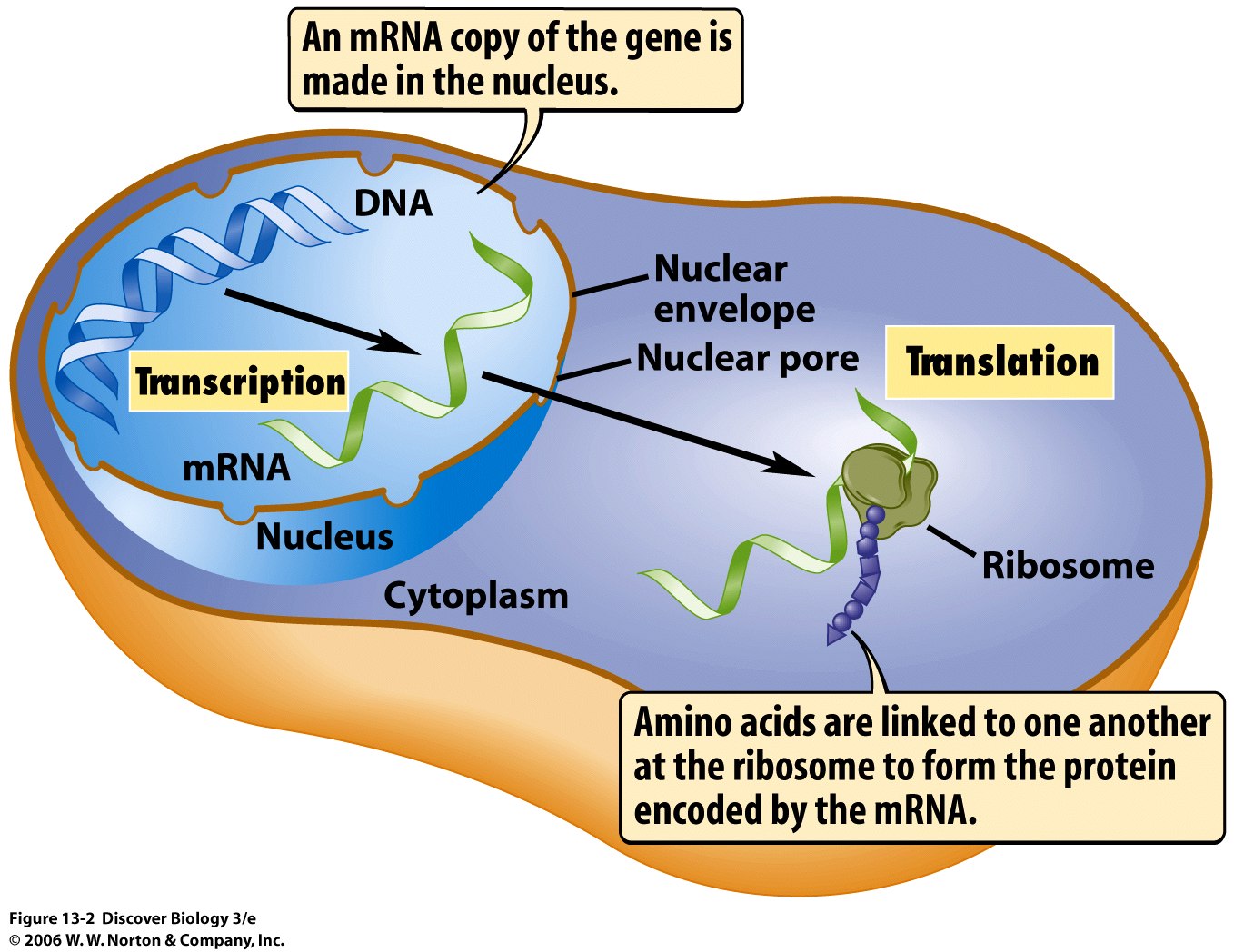
In short, every combination of three DNA letters (known as a ‘codon’) codes for a compound known as an amino acid. These amino acids are strung together into complex 3D shapes to form proteins, which are molecules that perform a lot of important tasks in an organism’s body. This decoding from DNA to protein requires transcription into an intermediate template, known as RNA, rendering the DNA code into a quite similar four letter language (only T is replaced by U for uracil). The RNA can then be translated by the protein-making machinery in the cell and this completes the decoding process.


Each letter in a codon can be A, C, G or T, so there are (4 x 4 x 4 =) 64 possible three-letter combinations of DNA bases that code for 20 amino acids (many amino acids have more than one corresponding DNA codon and there are a few ‘stop’ signals as well). Since most proteins are made out of dozens to hundreds, and sometimes even tens of thousands, amino acids, the number of combinations is quite large. All this based on a four-letter alphabet.
But what if we could add letters? What if we could extend the alphabet of life?
Spurred on by these questions, several groups of biochemists and molecular biologists set themselves to the task of designing new letters. Time to make our own additions to the story of life.
 

Writing new paragraphs

Of course, concocting new DNA letters is only the first step. If the additions are meaningless, or worse, distort the meaning of the rest of the alphabet, no novel paragraphs will be written. The new letters have to integrate into the already existing DNA. In other words, true success lies in the capacity of the man-made letters to be copied and translated alongside their older fellows.
This has proven to be a challenge. But, in the past few years, several teams have managed to overcome it. In fact, some expanded and functional six-letter alphabets have already been put together. Whether the new letters are called P and Z, or carry more complex names such as 5SICS and NaM, these extended alphabets have been shown to be copied and translated just as good as the basic one. And what’s more, they do not undergo these processes flawlessly. They can actually mutate just like regular DNA, allowing evolution to take its course using six letters instead of the usual four.
So, we have expanded alphabets, and they work. But can we use them to contribute to life’s grand tale? It turns out we can. The team behind 5SICS and NaM has succeeded in integrating their new letters into the DNA of a bacterium known as Escherichia coli, a popular organism in a lot of biological research. Not only did this little critter accept the new letters, but it replicated, transcribed, and translated them just like the A’s, C’s, G’s and T’s. It effectively became the first known living organism with a six-letter alphabet making up its vital biological library.
These initial story additions that use newly designed letters are still short and limited, but they open up a vast space of possible plot twists to be written as we get more proficient in using extended DNA alphabets. The content of these storylines could be as multifarious as life itself. Initial ideas involve thrillers about applied biosafety, adventures into realms of unknown or improved proteins, and chronicles from the clinic about detecting and monitoring diseases.
As progress is made on the implementation of new letters in life’s alphabet, the only limit seems to be our own imagination. Dystopian dread, utopian euphemisms or something more realistic altogether, what will it be? To successfully add paragraphs to a great story, careful copy-editing, reader feedback, collaborative writing, and the recognition of multiple interpretations can all help. Especially when using the language of life.
Whatever new plots that will emerge, they’ll surely be exciting.
 

References:

Hirao I, & Kimoto M (2012). Unnatural base pair systems toward the expansion of the genetic alphabet in the central dogma. Proceedings of the Japan Academy. Series B, Physical and biological sciences, 88 (7), 345-67 PMID: 22850726
Yang, Z., Chen, F., Alvarado, J., & Benner, S. (2011). Amplification, Mutation, and Sequencing of a Six-Letter Synthetic Genetic System Journal of the American Chemical Society, 133 (38), 15105-15112 DOI: 10.1021/ja204910n~
Malyshev, D., Dhami, K., Quach, H., Lavergne, T., Ordoukhanian, P., Torkamani, A., & Romesberg, F. (2012). Efficient and sequence-independent replication of DNA containing a third base pair establishes a functional six-letter genetic alphabet Proceedings of the National Academy of Sciences, 109 (30), 12005-12010 DOI: 10.1073/pnas.1205176109
Malyshev, D., Dhami, K., Lavergne, T., Chen, T., Dai, N., Foster, J., Corrêa, I., & Romesberg, F. (2014). A semi-synthetic organism with an expanded genetic alphabet Nature, 509 (7500), 385-388 DOI: 10.1038/nature13314
Image credits 1:  Magnus Manske: Location of eukaryote nuclear DNA within the chromosomes.
Image credits 2: csus.edu

The Perks Of Data Sharing

The access to biomedical research data is both a critical requirement and concern in the road to generating benefits to patients and society at large. In the scientific community there seems to be two “extreme” opinion sectors: those who firmly oppose steps for making data more accessible to all, and those who seek ways to free data of any restrictions for further uses.
The first group argues that the researchers responsible for acquiring the data should be the exclusive “owners” of that data. In this group you may find scientists who see other potential data users as “research parasites”. On the other hand, in the second group you have researchers who argue that data should be made available to the community without delays and favor full data openness.
Whether we feel closer to one group or the other, we cannot overlook a fact: It is time to talk about data sharing in a more dispassionate manner. Such a conversation will need to address two central questions: When and how should data be shared?
J. Wilbanks and S.H. Friend at Sage Bionetworks (Seattle, USA) have recently made a significant contribution to this conversation by reporting their motivation and experience in health data sharing. This follows Sage Bionetworks’ decision to share data obtained from thousands of participants of the mPower project, a smartphone-enabled study in Parkinson’s disease, even before the publication of their own analyses.

Data sharing: When?

According to Wilbanks and Friend, data sharing is especially needed in research areas where the problem of transforming raw data into interpretable findings has no generalized solutions. In their area, mobile health research, there is still a need to develop computational methods for making sense of these data. They argue that, by rapidly sharing such data, researchers will be enabled to come up with new tools to accelerate discoveries and applications, which in the long-term may result in benefits to patients.

Data sharing: How?

Scientists not only have a duty to maximize the potential value of their data, but also to enhance the conditions for their ethical use. To address these obligations, Sage Bionetworks’ approach does not solely rely on researchers or ethical committees to decide on who can re-utilize data. Instead, they directly allow the study participants to decide on whether or not other “qualified researchers” can access their coded data. In their project, more than 75% of the study participants chose to share their data widely. Participants can make this decision, or even modify it at any time, by using the study’s smartphone app.
Once researchers are given data access, additional restrictions are put in place, such as those concerning the commercial use or re-identification of the data. Additionally, there is the question of who can be recognized as a qualified researcher. To deal with this issue, Sage Bionetworks ask data requestors to complete various steps, including the validation of their identity and agreement to a data sharing contract.

Data sharing: Patients first.

Sage Bionetworks’ data sharing approach offers insights that go beyond the question of whether or not data should be shared. It reframes the discussion as a question of when (and how) to share data, according to the specific context and needs of a study. Although several legal and ethical concerns still remain, this approach at least aims to balance crucial requirements: the participants’ privacy and their motivation to support research, while promoting the transparent and ethical use of the data.
We should enhance the decision-making power of study participants to facilitate responsible and meaningful data applications. Decisions on when and how to share data should not be driven by the self-interest of scientists. The rationale should be grounded in the need to maximize the potential benefits to patients.
 
References:
Longo, D., & Drazen, J. (2016). Data Sharing New England Journal of Medicine, 374 (3), 276-277 DOI: 10.1056/NEJMe1516564
Wilbanks, J., & Friend, S. (2016). First, design for data sharing Nature Biotechnology DOI: 10.1038/nbt.3516
Bot, B., Suver, C., Neto, E., Kellen, M., Klein, A., Bare, C., Doerr, M., Pratap, A., Wilbanks, J., Dorsey, E., Friend, S., & Trister, A. (2016). The mPower study, Parkinson disease mobile data collected using ResearchKit Scientific Data, 3 DOI: 10.1038/sdata.2016.11

Bioterrorism: Lessons Learned From Anthrax

The word ‘terrorism’ is in everyone’s minds these days. Add the prefix ‘bio’ before and you make it even scarier. From Smallpox, Polio, Cholera, Ebola to Zika, those tiny creatures feed on human blood and insecurity. You cannot see them with the naked eye, but you know they can kill you without mercy.
For Robert Stevens, those tiny creatures had a tragic impact on his life. In October 2001, he was the first person to die from anthrax inhalation in 25 years in the United States. The episode happened only a few days after the 9/11 attacks, when several letter containing the deadly disease were mailed to media companies and US senates.
Besides Stevens, four other people died from anthrax inhalation and, since then, the words anthrax and bioterrorism became almost inseparable. If another bioterrorist attack were to happen, anthrax would most likely be the chosen weapon, since its spores are easily spread in the environment, they can be easily inserted in food, sprays and powders and, most importantly, its efficacy as a biological weapon is already proven, in several occasions.

How does anthrax kill?

Anthrax is a disease caused by Bacillus anthracis. Infection occurs after the bacteria’s spores enter the blood stream of other organisms, mainly by one of these three routes: pulmonary, cutaneous and gastrointestinal.
[su_spoiler title=”Pulmonary” style=”fancy” open=”yes”]Infection by inhalation is the less frequent but the most likely to happen in a bioterrorist attack. It was the case for Robert Stevens. After opening the anthrax letters, thousands of deadly spores traveled through Stevens’ lungs without any notice. There, they were eaten by Stevens’ immune cells, migrating to his lymph nodes, where they were then able to multiply. After being admitted in the JFK Medical Center, Stevens suffered several seizures and died three days after. [/su_spoiler]
[su_spoiler title=”Cutaneous” style=”fancy” open=”yes”] Cutaneous infection occurs mainly after humans come into contact with wool, hair or bones of infected animals. A small break or fissure is sufficient for Bacillus anthracis to penetrate the skin and infect humans. Thus, farmers, veterinarians and wool workers are more proned to get anthrax via this route. [/su_spoiler]
[su_spoiler title=”Gastrointestinal” style=”fancy” open=”yes”]Poorly cooked meat from sick animals is the most common cause of gastrointestinal infections by anthrax. After spores are deposited in the gastrointestinal track, they cause oral ulcers, fever, vomiting and other severe complications. Diagnosis is rarely made on time and victims die within 2 or 3 days after infection, via bowel perforation and shock. [/su_spoiler]
The key to Bacillus’ ability to infect people is the presence of the so-called virulence factors, called plasmids pXO1 and pXO2. [expand] While pXO2 plasmid is responsible for the formation of a capsule necessary for infection mechanisms, pXO1 is responsible for the production of toxins that cause cell death and edemas [/expand]
Inside the host, Bacillus anthracis takes the form of vegetative cells. However, when there is a lack of certain nutrients, the bacteria forms spores, which are released into the environment and are responsible for spreading the disease. Koch and Pasteur contributed greatly to the understanding of the disease mechanisms  in the 19th century, by studying how anthrax-infected animals were able to contaminate humans.

Preparedness vs. Ignorance

But are microorganisms, such as the Bacillus anthracis, secretly plotting a bioterrorist attack on the human race? That is not quite the case: one can only speak of bioterrorism when the virus, bacteria, or other types of organisms or toxins, are deliberately released to cause illness or death. There must be a human brain orchestrating it.
Bioterrorism harms mostly by creating a sense of permanent fear. As long as that sense prevails, terrorism wins. But while public’s fear is the triumph of bioterrorists, preparedness might prevent a calamity. Governments draw endless guidelines, citizens struggle to stay informed on potentially fatal organisms and Universities try to educate their students. The University of New South Wales, in Australia, prepared a Bioterrorism and Health Intelligence course for professionals involved in bioterrorism preparedness in modern days. To demonstrate the content of the course and to give a perspective of what a bioterrorist attack might look like, the University created a fictional series called Pandemic.
[su_youtube_advanced url=”https://youtu.be/bVvUGWkHlUQ” width=”520″ height=”320″ responsive=”no”]Pandemic[/su_youtube_advanced]
The line is thin between awareness and panic. But keeping citizens in ignorance never resulted in any good for society; and while fear might be the fuel of bioterrorism, preparedness might as well be the fire-blanket that will keep the house from burning.
References:
Goel, A. (2015). Anthrax: A disease of biowarfare and public health importance World Journal of Clinical Cases, 3 (1) DOI: 10.12998/wjcc.v3.i1.20
Riedel S (2005). Anthrax: a continuing concern in the era of bioterrorism. Proceedings (Baylor University. Medical Center), 18 (3), 234-43 PMID: 16200179
Anderson, P. (2012). Bioterrorism: Toxins as Weapons Journal of Pharmacy Practice, 25 (2), 121-129 DOI: 10.1177/0897190012442351
Ten Years Ago Today the Anthrax Nightmare Unfolded, and Globalized
Timeline: How The Anthrax Terror Unfolded
F.B.I., Laying Out Evidence, Closes Anthrax Case

Coffee’s Guilty Pleasure

Last December, the Institute where I work at changed out the coffee machines in the cafeteria and the replacement drinks were utterly disgusting. My team and I were soon tempted by the idea of getting our own personal coffee machine. We could not resist buying it. This new coffee machine is attractive, compact and best of all makes great coffee, but there is a downside: it’s one of these newer single serving coffee-makers with individual capsules or pods. It’s a nice concept until we realized that only one brand’s pods are recyclable in Switzerland, and it is definitely not ours. In this country, each used pod would end up in the incinerator! This is a staggering amount of waste in a place where the average person drinks 1,300 cups of coffee yearly.
As someone who strives to only use reusable and recyclable items, this was a major problem. A catastrophe growing by one exhausted pod at a time. I was just about ready to get out a whip and chastise myself, but instead I opted for another form of punishment which involved tedious research on how to disassemble, reuse, and recycle most components of the pods or capsules. One must only peel off the thin film, separate the different plastics from the aluminum foil and the coffee grounds. Plastics would be brought to my hometown, where recycling of plastics is advanced, the aluminum bits would be deposited at local recycling points, and the coffee grounds would make a perfect body scrub. It would be time consuming, but worth it. I felt proud of myself.
One of my colleagues, originally from Hamburg, always joked about this sort of thing, but lately he has confessed that he has begun to feel guilty about his coffee-pod-based ecological footprint. In his hometown, coffee pods have just been banned from public offices. This news was so unsettling to my German friend that now he always helps me disassemble the pods; and he does so exclaiming how happy he is that dolphins are not dying with his coffee pods in their throats.

One part guilt, one part pride.

We all know that our feelings affect our everyday actions, and vice versa. Yet, we haven’t much of a clue as to how or why. Most of the time it translates into shouting at your partner for no real reason, or spontaneously bringing a cake at work. But what if this interconnectedness of emotion and action could have a bigger impact, on, say, climate change?
A research team from the University of Queensland recently investigated the relationship between the emotions of pride and guilt and eco-friendly behavior. The study participants were all Australian university students, (61 female and 35 male), and therefore represent one the most consistently pro-environment communities. In fact, geographical origins, education, and sex influences our personal environmental perspective. The research team observed 65% of participants had feelings of pride after doing something eco-friendly. In addition, the more people perceived that their communities are involved in pro-environment actions, the more pride they feel when engaged in such activities. After all, we like being legitimized by our peers.
Guilt can also be an effective tool, as evidenced by the route my colleague took to eco-consciousness. Though, guilt, by itself, does not seem to push us to “do better next time” as well as it should, as the study indicates. Nonetheless, we can see how frequently environmental campaigns’  slogans are based on this very principle, stressing that it is entirely our fault that the Earth is dying and that the situation is grim. Recall the Brandalism artworks installed across Paris before the launch of the UN COP21 Climate Conference. It’s reminiscent of the oppressive sense of sin, shame and guilt that pervaded medieval Christianity. The difference is that nowadays we know that self-chastising is not going to solve any problems. Instead, might we positively engage the already guilty feeling communities and recognize their pro-environment achievements? Perhaps it is time we take a fresh look at how we structure ecological initiatives and how we can use our own human nature of wanting to be legitimized by the tribe to do some real good for the planet.
We all feel guilty on varying levels: but if this guilt alone is not enough to enact any change, we’d be silly to keep trying to guilt ourselves into recycling our old coffee pods. In reality, a healthier approach would be to recycle the pods with somebody else. In this way we could challenge each other: you are doing great recycling these coffee pods, but what if we could get everybody to use a percolator next time?
Source:
Bissing-Olson, M., Fielding, K., & Iyer, A. (2016). Experiences of pride, not guilt, predict pro-environmental behavior when pro-environmental descriptive norms are more positive Journal of Environmental Psychology, 45, 145-153 DOI: 10.1016/j.jenvp.2016.01.001

Fairness In Science: What For?

0

Fairness: a crucial value to scientists

Journals and funding agencies ask their reviewers to be fair in their decisions. Committees are expected to act fairly in their evaluations concerning recruitment and promotions. Universities and other research organizations seek to embed fairness into their core values and policies.
And yet, what is it all for?
As a general rule, we understand fairness as the sense that the procedures behind any decision or interpretation potentially affecting us are: unbiased, proportionate and transparently applied.
This sounds like the central tenets of scientific research. Doesn’t it? Researchers usually know that they thrive and science advances only in the presence of these three attributes. But there is something stronger beneath that: science firmly rests on honesty, which in turns feeds on trust, and you cannot have trust where fairness is missing or ignored.
The scientific enterprise is mainly driven by the ambition of its members to achieve progress and to eventually benefit society: ranging from the most fundamental to the most applied aspects of their work. An almost blazing desire to search and to discover, the aspiration of advancing collectively or even of “moving up” as individuals. In science, like in free societies, such ambitions are typically constrained, or to a large extent moderated, by a strong set of norms and moral values. Norms and values that also rely on notions of fairness.
 

[su_quote cite=”Phoclydes”]“Give no decision till both sides thou’st heard”. [/su_quote]


Fairness in the knowledge economy

In an age of never-ending growth, performance-oriented organizations and technological “disruption”, fairness also has a more practical value.
Research shows that employees are more engaged when they feel that decisions are made and executed in a fair manner. There even seems to be a correlation between employees’ perceptions of a lack of fairness and straightforward negative behaviour, such as absenteeism and procedural noncompliance. But it is not just about boosting employee motivation and job satisfaction. It is more than that. It is also about creating the conditions for sustaining trustworthy, long-term collaborations. This is necessary if we wish to create environments where both ethical and productive behaviour can truly flourish.
So, fairness should go well beyond legalistic guidelines or self-congratulatory advertising of management excellence. It is both a fundamental value in science and a functional instrument for generating socio-economic benefits. Fairness helps us connect to our co-workers, employers and society at large. Conversely, unfairness can nurture an atmosphere of internally-destructive fear. Ah, fear: that measurable impediment to innovation .
And fear can also badly tear us apart: In science, as in democracies.
 

Sources:
Holtz, B., & Harold, C. (2010). Interpersonal Justice and Deviance: The Moderating Effects of Interpersonal Justice Values and Justice Orientation Journal of Management, 39 (2), 339-365 DOI: 10.1177/0149206310390049
Williams D.K. and Scott M.M. Conquering The Enemies of Innovation: Silence and Fear. Harvard Business Review 2012

Tricoles, R. (2012) Fairness in Workplace Key to Employee, Organizational Health

Image Source: By Unknown photographer [Public domain], via Wikimedia Commons

The Rise And Fall Of Alexandria’s Library

Knowledge sharing: from Alexandria’s Library to Open Access.

[su_dailymotion url=”http://www.dailymotion.com/video/x3c5wln_cosmos-a-spacetime-odyssey-hd-episode-13-unafraid-of-the-dark_school#tab_embed” quality=”240″ related=”no”]
History has told us that blood spilling is the most common result of a rivalry between ancient cultures. But Alexandria’s Library is an exception to this rule: knowledge blossomed from competition and the greatest library in the world was born (blood was also involved, though).
Around the year 300 BC, Demetrius of Phalerum was appointed by the Macedonian king to govern Athens. After a successful period ruling Athens, Demetrius had to escape to the court of Ptolemy I, in Alexandria. There, he convinced Ptolemy I to build the ‘Musaeum’ – the modern word ‘museum’ derives from this period – the first piece of the Alexandria’s Library complex puzzle. Demetrius dreamt of a library that contained a copy of every book in the world: a library that could compete with the rivals in Athens.

A copy of every book in the world

The Museum was a religious institution, a tribute to the Muses, the Greek goddesses of artistic and intellectual pursuit. But the Museum was, above all, a place for cultural sharing, with lecture areas, laboratories, botanical gardens, a zoo and, of course, the library itself. Alexandria’s Library soon outcompeted Athens’ schools, with famous thinkers such as Euclid, Archimedes, Herophilus, [su_lightbox src=”https://www.youtube.com/watch?v=nRkReKGFqHY”]Hypatia[/su_lightbox], and Aristarchus of Samos. The Alexandria’s Library sponsored scholarly activity, rather than sponsoring individuals, as happened in Athens’ schools. In theory, its intellectual legacy would last far longer than that of the Greek empire, it would travel for generations to come.
The Ptolemy clan’s hunger for knowledge was well-known. They were determined to have a copy of every book in the world. Buying books in Athens’ markets was one way of increasing their collection, but they went further, by dictating that all ships arriving at Alexandria’s harbors must be inspected. Every book found was taken away and copied. Alexandria’s Library would keep the originals and return the copies to its previous owners. The Library’s magnitude was unprecedented. Legend has it that more than half a million documents, mainly papyrus scrolls, were stored in its walls.

The fall of a symbol

Nowadays, the Library of Alexandria is perhaps best known as a symbol of knowledge destruction than a symbol of knowledge itself. What exactly happened and who was responsible for it is still a mystery, even though it is commonly believed that the library was burned. Several authors account Julius Caesar  responsible for the tragedy. In 48 BC, during Alexandria’s occupation, he had one of his men set fire to Egyptian boats, but it is believed that the fire eventually got out of control and spread to the library’s warehouse.
Records show that the Library still existed after Caeser’s invasion, so he was not the only one responsible for the Library’s destruction. When paganism was made illegal, in 391, Theophilus of Alexandria decreed that a Christian church should be built on the site of one of the Library’s former buildings. Later, in 642, the Arabian army, led by Amr ibn al `Aas, captured Alexandria. The story goes that, when asked what to do with the library, Amr replied that “either the books contradict the Koran, in which case they are heresy, or they agree with it, in which case they are unnecessary”.
In an age where knowledge is one click away, one screen afar, the importance of the Library of Alexandria, and its subsequent destruction, is perhaps hard to grasp. But the very concept of knowledge sharing is one that is not strange to United Academics. Hundreds of years later, we don’t need to search for books in ships; open access will do the job.
 
Sources:
Erskine, A. (2009). Culture and Power in Ptolemaic Egypt: the Museum and Library of Alexandria Greece and Rome, 42 (01), 38-48 DOI: 10.1017/S0017383500025213
Brian Haughton. “What happened to the Great Library at Alexandria?,” Ancient History Encyclopedia. Last modified February 01, 2011. http://www.ancient.eu /article/207/
Cosmos: A Spacetime Odyssey HD | Episode 13 : Unafraid of the Dark

Once Upon a Time… On the Origin of Fairytales

2

Once upon a time, around 6 000 years ago, there lived a blacksmith. This blacksmith was a true craftsman, always looking for ways to improve his metal-moulding skills. When he had practised all he could, he saw only one way towards perfection: a demonic deal. So he called forth a powerful demon – some might say the devil himself – and bought the ability to weld any material. The price? His soul… Read on and find out whether he paid or not…

The evolution of stories

Evolution is one of the most powerful and well-founded scientific theories. Life evolves. One of the fundamental ideas in evolution is descent with modification. You’re not exactly like your parents or your sibling. This variation (if it’s heritable and affects fitness) provides evolution material to play with.
But it aren’t just populations of living organisms (or more precisely, gene pools) that evolve. Cultures and ideas evolve as well. That is why recently linguists and social scientists have begun to use methods originally developed by evolutionary biologists to investigate the origin and evolution of, for example, languages and artefacts.
Stories, which are a great way to study language as well as the culture that formulated them, evolve as well. A new study, published in Royal Society Open Science by scientists from the University of Lisbon in Portugal and the University of Durham in the UK, dives into the evolution of fairy tales.

Time for tales of magic

To select their stories, the authors turned to the Aarne Thompson Uter (ATU) index, a catalogue of more than 2 000 ‘international tale type’ from across 200 societies. They decided to focus on the largest and most widely shared group of stories: tales of magic, which contain the much-beloved fairy tales.
Now, stories can be transmitted both vertically, from ancestral populations to their offspring, and horizontally, between societies in the same time-period. By combining evolutionary trees and detailed maps of the cultures involved, the authors could separate these two modes of transmission. They found that 100 of their original 275 tales were much more similar than expected through chance, and that for 76 of those vertical transmission was more important than horizontal transmission.
To uncover the evolutionary history of fairy tales, these 76 would provide the key ingredients.

Ancient roots and a Bronze Age fairy tale

Using methods borrowed from evolutionary biology, the researchers could trace back the shared history of those 76 tales of magic. By tallying which tales were shared by which populations they could step back in tale time. If one of these 76 stories (vertical transmission, remember) is shared among lots of populations, then that tale probably has an ancient origin. And so, the researchers descended the evolutionary tree of tales.
This showed that many fairy tales could be quite a bit older than previously thought. Beauty and the Beast, and Rumpelstiltskin, for example, were only written down in the 17th or 18th century but, according to this study, have been part of our cultural heritage from somewhere between 6 000 and 2 500 years ago. What’s more, going all the way back through ancient language groups they even managed to identify four ‘ancestral’ stories whose origins probably lie in the Proto-Indo-European. And one of these ancient fairy tales, The Devil and the Smith, was very likely already around 6 000 years ago.

The story behind the tale

Knowing the evolutionary history of fairy tales is not just interesting in itself, but it can also teach us a lot about the culture that spawned them and help us evaluate hypotheses about history. To return to our fairy tale, the blacksmith, who sells his soul to an evil power for the ability to weld any materials together, ends up using his gift to weld the demon to a tree. To imagine a story like this, you’d have to know about metallurgy. This suggests that Proto-Indo-European languages arose around 6 000 years ago on the Russian steppes (the ‘Kurgan’ hypothesis’), and probably not 9 000 years ago in Turkey when there was no metallurgy there (the ‘Anatolian hypothesis’).
This study shows that fairy tales have probably been around for a long time, dispelling the notion that they are a fair(l)y (see what I did there?) recent phenomenon. It’s also interesting to see that some tales do well, whereas others do less. Some spread easily among cultures, others do not. And finally, evolution teaches us not just about the living world, but also about our culture and the imaginary worlds we’re so good at making.
And they live happily ever after…?
Source:
da Silva, S., & Tehrani, J. (2016). Comparative phylogenetic analyses uncover the ancient roots of Indo-European folktales Royal Society Open Science, 3 (1) DOI: 10.1098/rsos.150645